

How to Do SEO for a New Website: Get Ranked in SERPs & LLMs Faster
Launching a website is easy. Getting it discovered by Google, AI search engines, and potential customers is where the real challenge begins. Without a clear SEO strategy, even valuable websites often struggle to generate consistent visibility.
Many website owners focus on design, products, or services first, then realize organic traffic is not arriving as expected. Search engines need clear signals to understand your website, trust its content, and determine where it should rank.
At the same time, search is evolving beyond traditional rankings. Large Language Models (LLMs) increasingly influence how users discover information, making website optimization more important than ever before.
This guide explains how to do SEO for new website, from foundational setup and keyword research to content, technical SEO, and authority building. You’ll learn practical steps that help new websites gain visibility, rankings, and sustainable organic growth.
How SEO Works for a New Website?
Before understanding how SEO works for a new website, it’s essential to grasp what SEO is.
SEO (Search Engine Optimization) is the process of helping search engines understand, trust, and rank your website for relevant searches.
Many website owners assume rankings depend solely on publishing content. In reality, search engines evaluate hundreds of signals before determining visibility.
For a new website, the challenge is even greater because search engines have little historical data to assess. Before your website starts ranking, search engines must understand your website’s purpose, expertise, content quality, and overall credibility.
This is why SEO focuses on building strong relevance and trust signals from the very beginning.
At a fundamental level, SEO works by improving three critical areas:
| SEO Pillar | Why It Matters |
| Relevance | Helps search engines understand what topics your website covers |
| Authority | Demonstrates expertise and trustworthiness within your industry |
| User Experience | Ensures visitors can easily access and consume your content |
When these signals align together, search engines gain greater confidence in recommending your pages for relevant searches.
For example, if someone searches for “how to do SEO for a new website,” Google compares thousands of competing pages. The pages that best satisfy search intent, demonstrate expertise, and provide value typically earn stronger rankings.
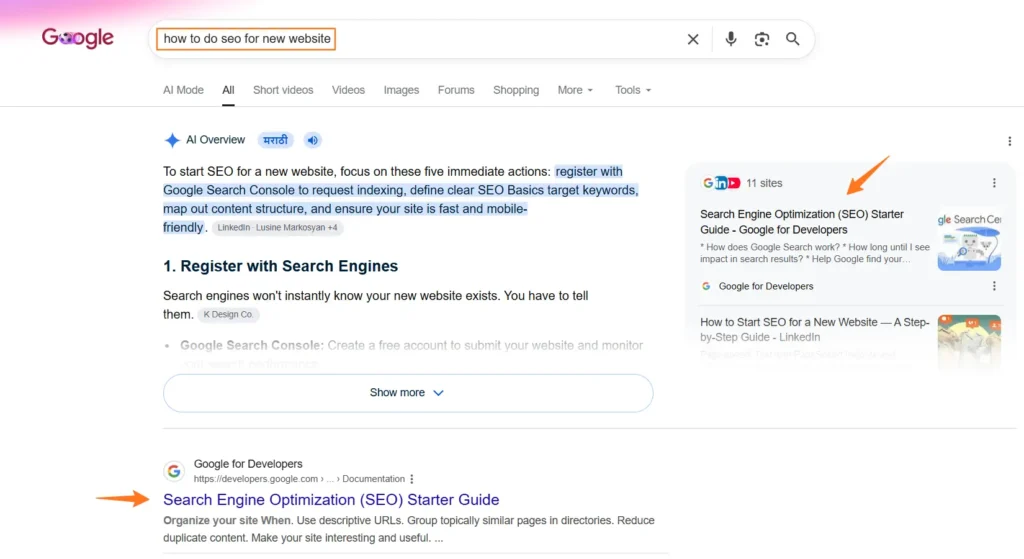
This process begins long before a page reaches the first page of search results.
Search engines first discover your website, crawl important pages, analyze content, evaluate technical performance, and assess authority signals.
Only after collecting enough evidence can search engines determine where your website should appear within search results.
Modern SEO extends beyond traditional rankings. AI-powered search experiences increasingly rely on trusted sources when generating responses.
As a result, successful SEO today is not simply about ranking pages. It is about becoming a trusted source. A website that consistently demonstrates expertise, authority, and usefulness gains stronger visibility across both search engines and LLMs.
Also Check: Generative Engine Optimization (GEO): How It’s Changing SEO?
How Search Engines & LLMs Treat New Websites?
One of the biggest misconceptions in SEO is believing that publishing a website automatically leads to rankings.
In reality, search engines treat new websites very differently from established websites with years of history and trust.
When Google discovers a new website, it has limited information available to evaluate its credibility and expertise. As a result, the website enters what many SEO professionals refer to as a trust-building phase.
During this stage, search engines continuously collect data before assigning stronger rankings to important pages.
This evaluation process typically focuses on several foundational signals:
| Signal | Why It Matters for New Websites |
| Content Quality | Helps search engines understand expertise and usefulness |
| Website Structure | Improves crawling, indexing, and content discovery |
| Technical SEO | Ensures pages can be accessed and evaluated correctly |
| Backlinks | Provide external trust and authority signals |
| User Experience | Indicates overall website quality and usability |
A new website with excellent content can still struggle if these foundational signals are weak or inconsistent. This explains why some websites publish dozens of articles but generate little organic visibility initially.
Search engines need enough evidence before confidently recommending a new source to searchers.
LLMs approach new websites in a similar way, although their evaluation methods differ from traditional ranking systems.
Instead of focusing primarily on rankings, LLMs look for signals that indicate reliable, accurate, and well-structured information.
Websites with shallow content, inconsistent expertise, or limited topical coverage often struggle to gain visibility across AI-driven experiences.
On the other hand, websites that demonstrate clear expertise around a specific subject become easier to understand and trust.
The comparison below highlights how both systems typically view new websites:
| Evaluation Factor | Search Engines | LLMs |
| Website Age | Consider historical performance and trust growth | Less dependent on age alone |
| Content Quality | Strong ranking factor | Strong understanding signal |
| Authority Signals | Backlinks and brand mentions matter | Source credibility matters |
| Topical Expertise | Important for rankings | Important for inclusion and trust |
| Technical Structure | Critical for crawling and indexing | Helps content interpretation |
This is why successful SEO begins with strong content, clean website architecture, technical optimization, and topical expertise.
The more confidence search engines and LLMs develop in your website, the more visibility your content can earn over time.
Now, here are the step-by-step instructions on how to do SEO for your brand-new website.
Step 1: Set Up SEO for Your New Website
Before researching keywords or publishing content, your website needs a strong SEO foundation. Many ranking issues originate from improper setup rather than poor content or weak keyword targeting.
Think of SEO setup as preparing a website for discovery, crawling, indexing, measurement, and long-term growth.
Without these essentials, search engines may struggle to understand your website correctly from the beginning.
A proper SEO setup ensures every future optimization effort contributes toward rankings instead of fixing preventable issues.
The first priority is connecting your website with the tools search engines provide.
Two platforms should be configured immediately after launching your website:
| Tool | Purpose |
| Google Search Console | Monitors indexing, crawling, search performance, and website health |
| Google Analytics 4 | Tracks visitors, engagement, traffic sources, and conversions |
Google Search Console allows you to submit important pages and monitor how Google views your website. Without it, identifying indexing problems and technical SEO issues becomes significantly more difficult.
Once connected, submit your XML sitemap to help search engines discover pages more efficiently.
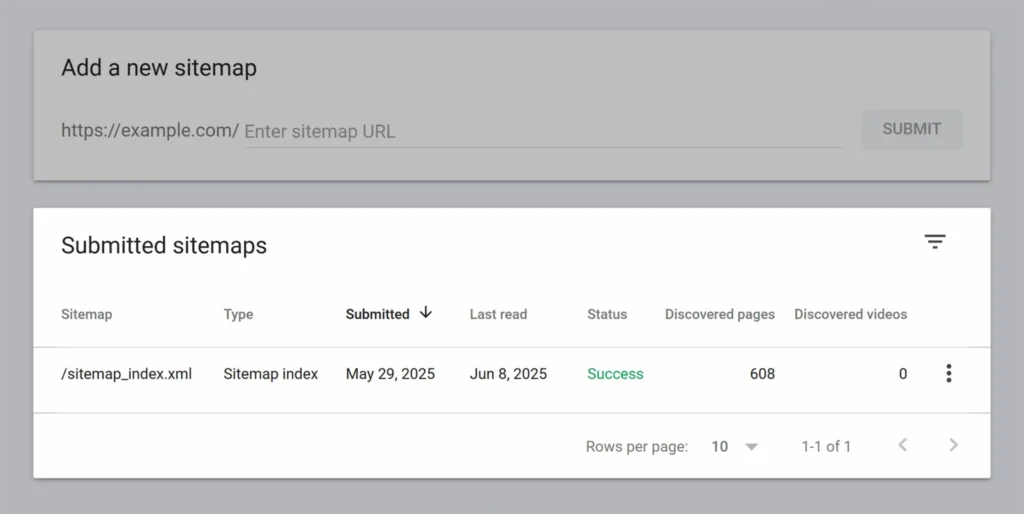
An XML sitemap acts like a roadmap that guides crawlers toward important website content.
Now, you need to verify that search engines can actually access your website.
Incorrect robots.txt rules, noindex tags, or development settings frequently prevent new websites from appearing in search results.
This issue is surprisingly common, especially when websites move from staging environments to live servers.
After indexing settings are verified, focus on creating a clean website structure.
Search engines prefer websites that organize pages logically and make information easy to discover. For example, service pages, blog content, and resource sections should each have clearly defined URLs.
A simple structure helps both users and search engines navigate your website efficiently.
Technical performance should also be addressed before aggressive SEO campaigns begin.
Slow-loading pages, mobile usability problems, and broken links can weaken important trust signals early.
The checklist below summarizes the essential setup tasks for new websites:
| SEO Setup Task | Priority |
| Configure Google Search Console | High |
| Configure Google Analytics 4 | High |
| Submit XML Sitemap | High |
| Verify Indexing Settings | High |
| Create SEO-Friendly URL Structure | High |
| Test Mobile Responsiveness | High |
| Improve Core Website Speed | Medium |
| Fix Broken Links and Errors | Medium |
Completing these foundational tasks creates an environment where future SEO efforts can perform more effectively.
Once your website is technically ready, the next step is identifying the keywords your audience actively searches for you.
Step 2: Conduct Keyword Research for Your New Website
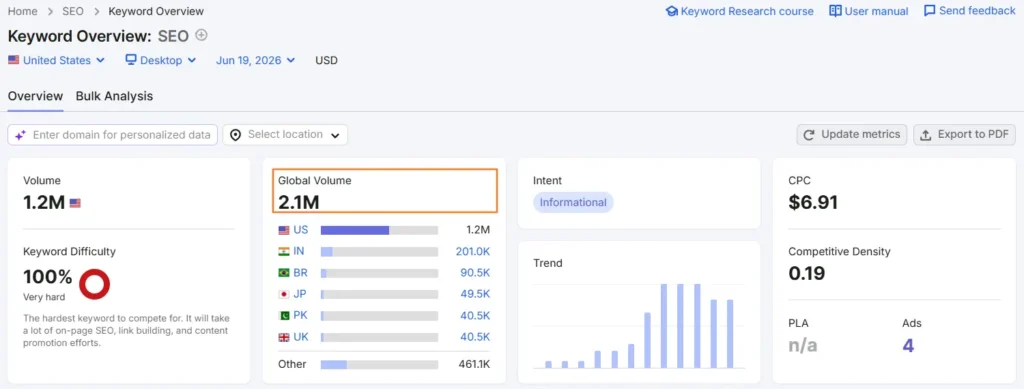
Keyword research is where most new websites either gain early traction or waste months on irrelevant targeting.
At this stage, your goal is not traffic volume. It is ranking feasibility plus intent alignment.
New websites rarely rank for broad, high-competition keywords because authority signals are still weak. So the strategy shifts toward precision: low-competition, high-intent, and context-specific keywords.
Start by identifying what your audience is trying to solve, not just what they are searching for.
Then map those problems to search queries with clear intent.
For new websites, long-tail keywords are the primary entry point into organic visibility.
For example:
- Broad keyword: SEO
- Target keyword: how to do SEO for a new website
The second option works because it matches intent and reduces competition pressure.
A structured keyword approach looks like this:
| Keyword Type | Purpose | Priority for New Websites |
| Long-tail keywords | Capture specific intent | High |
| Problem-based keywords | Solve user queries | High |
| Competitive head terms | Build future authority | Low (early stage) |
| Brand keywords | Build recognition | Medium |
Search intent must also guide every keyword decision. If intent is wrong, rankings become irrelevant even if traffic increases.
| Intent Type | Example | Usage |
| Informational | how to do SEO for a new website | Blog content |
| Commercial | best SEO tools for beginners | Comparison pages |
| Transactional | hire SEO expert | Service pages |
Topical clustering is another critical factor often ignored by beginners.
Instead of targeting scattered keywords, group them into themes around your core offering. This helps search engines understand your website’s focus faster and more clearly.
When selecting keywords, evaluate them using four filters:
- Can a new website realistically rank for this?
- Does it match user intent precisely?
- Does it support your core topic authority?
- Can it lead to conversions or meaningful engagement?
Avoid choosing keywords only based on search volume. It is a misleading early-stage metric.
Low-volume, high-intent keywords often generate faster rankings and stronger engagement signals.
Once your keyword list is defined, it becomes the foundation for on-page SEO, content planning, and internal linking structure.
Step 3: Optimize Your Website Pages for SEO
On-page SEO is where keyword strategy converts into actual ranking signals.
If keyword research defines targeting, on-page SEO defines how clearly search engines interpret your page. Most new websites fail here because pages are either over-optimized or lack proper structure.
The objective is simple: make every page easy for search engines to understand and users to trust.
Proper page structure includes:
- Title Tag: Defines primary ranking relevance
- Meta Description: Improves click-through rate from search results
- H1 Heading: Represents the core page topic
- H2/H3 Headings: Break content into structured sections
Content quality creates the biggest ranking difference, not just keyword placement.
Search engines compare pages based on depth, clarity, and usefulness rather than keyword frequency. A strong page fully answers the query without forcing users to search elsewhere.
Keyword placement should also feel natural, not forced, as overuse reduces clarity and trust signals. Images also contribute to on-page SEO when optimized properly. They should be compressed, contextually relevant, and include descriptive alt text for accessibility and indexing.
Internal linking strengthens page relationships and distributes authority across your website.
For new websites, internal links often deliver more early impact than external backlinks.
Talking about URL structure, it should stay clean, readable, and logically organized. A simple URL like “/seo-for-new-website” performs better than complex or parameter-heavy structures.
Core on-page SEO checklist:
- Use one clear H1 per page
- Include primary keyword naturally in title
- Write intent-focused meta descriptions
- Structure content with H2 and H3 headings
- Optimize images using compression and alt text
- Add relevant internal links across pages
- Keep URLs short and readable
On-page SEO is no longer about keyword density. It is about clarity, structure, and intent alignment.
When executed properly, it helps search engines understand your page without ambiguity or guesswork.
Once pages are optimized, the next step is building a site structure that helps search engines crawl and connect content efficiently.
Step 4: Build an SEO-Friendly Website Structure
Website structure decides how search engines interpret relationships between your pages and overall topic authority.
For new websites, structure is not optional design work. It is a ranking foundation that affects indexing and visibility.
If search engines cannot understand your structure, even stronger content struggles to gain consistent rankings.
To do it properly, start by defining your website’s core topic areas before publishing any large volume of content. Each website should be built around a small number of clearly defined themes tied to business intent.
Avoid publishing pages without understanding how they connect to your main topics or services.
Think in clusters, not individual pages. Each cluster should support one central topic.
A practical structure looks like this:
- Homepage acts as the central authority hub
- Core category pages define main topics or services
- Supporting pages expand each category with depth
- Blog content strengthens topical clusters
Internal linking connects these layers and helps search engines understand your content hierarchy.
Without it, pages become isolated and fail to pass relevance signals across the website.
Every important page should be reachable within 2–3 clicks from the homepage for optimal crawl efficiency.
URL structure must mirror your hierarchy instead of functioning as random page identifiers.
Examples of clean, SEO-friendly URLs:
- /services/seo
- /services/content-marketing
- /blog/seo-for-new-website
This structure improves both crawl clarity and user understanding of page context.
Keep navigation simple in early stages instead of building unnecessary complexity.
A lean structure with strong internal connections performs better than large unorganized websites.
Core structure principles:
- Define topic clusters before publishing content
- Maintain clear hierarchy from homepage to subpages
- Ensure every key page is internally linked
- Keep important pages within 2–3 clicks of homepage
- Use descriptive anchor text for internal links
- Maintain consistent URL patterns across the site
A well-structured website reduces search engine confusion and improves how quickly content gets indexed. Once structure is correct, your website becomes ready for scalable content growth and stronger ranking stability.
Step 5: Create Content That Drives Rankings
Content is what gives search engines a reason to rank your website.
Without content, there are no keywords to target, no topics to build authority around, and no opportunities to earn traffic.
However, publishing content alone is not an SEO strategy.
Many new websites publish dozens of articles but see little growth because they focus on quantity instead of relevance. The goal is to create content that aligns with search intent and strengthens your topical authority.
To do it perfectly, you can focus on topics that are directly related to your products, services, or expertise. For example, an agency should prioritize topics related to its services, like SEO, influencer marketing, social media, etc.

Publishing unrelated topics may generate traffic, but it rarely contributes to long-term authority. So, here’s how you should think about it:
- Create a pillar page around a broad topic
- Publish supporting articles around related subtopics
- Connect them using internal links
- Continuously update content as topics evolve
This approach helps search engines understand the depth of your expertise within a subject area.
Content quality also matters more than ever. Google’s helpful content systems are designed to reward content that genuinely helps users solve problems. Instead of asking, “How many articles should we publish?”, you should be asking, “Does this content answer the user’s question completely?”
Strong SEO content usually includes:
- Clear answers to the search query
- Accurate and up-to-date information
- Real examples, insights, or experience
- Logical structure and readability
- Supporting visuals, data, or references where relevant
Another mistake new websites make is targeting a keyword only once. Topical authority develops when multiple pages cover different aspects of the same subject. For example, a website targeting SEO could create content around:
- Keyword research
- On-page SEO
- Technical SEO
- Link building
- Local SEO
- SEO audits
Together, these pages create stronger topical signals than a single article ever could.
Content should also be optimized for both search engines and AI-powered discovery platforms.
When content consistently solves user problems, rankings, visibility, and authority become much easier to earn.
Step 6: Implement Technical SEO Best Practices
Technical SEO ensures search engines can access, crawl, understand, and index your website without obstacles.
You can publish excellent content, but rankings will suffer if search engines encounter technical issues.
For new websites, technical SEO is often easier to implement early. This is important to make sure we remove barriers that prevent search engines and users from accessing content efficiently.
For this, you can start with crawlability and indexability.
Verify the following essentials:
- Important pages are set as “indexable”.
- robots.txt is configured correctly.
- XML sitemap is submitted to Google Search Console.
- No accidental noindex tags exist on key pages.
Website speed should be the next priority. Slow websites create a poor user experience and reduce overall site efficiency. Therefore, focus on these practical improvements:
- Compress images before uploading.
- Remove unnecessary scripts and plugins.
- Enable browser caching.
- Use a reliable hosting provider.
- Minify CSS and JavaScript files where possible.
Mobile usability is equally important. It primarily uses the mobile version of a website for indexing and ranking purposes. Your website should function properly across different screen sizes without layout or usability issues.
Another area often overlooked by beginners is technical page health.
Regularly monitor your website for:
- Broken internal links
- Redirect errors
- Duplicate pages
- 404 errors
- Server-related issues
These problems may seem minor individually, but they accumulate and collectively weaken the overall quality of the website.
Technical SEO also helps search engines understand website structure more effectively. So, here’s a core technical SEO checklist to follow:
- Submit XML sitemap (usually available at yourdomain.com/sitemap.xml and submit it through Google Search Console)
- Configure robots.txt correctly (check yourdomain.com/robots.txt and ensure important pages are not blocked)
- Ensure important pages are indexable (inspect pages in Google Search Console and verify they are not marked as “noindex”)
- Improve website speed (test performance using Google PageSpeed Insights and optimize slow-loading resources)
- Optimize mobile usability (review your website across mobile devices and fix layout, readability, or interaction issues)
- Fix broken links and crawl errors (monitor Google Search Console for 404 errors, crawl issues, and broken internal links)
- Maintain clean redirects (use 301 redirects for moved pages and avoid redirect chains whenever possible)
- Use HTTPS across the entire website (confirm every URL loads securely using HTTPS instead of HTTP)
- Check for duplicate versions of your website (ensure only one version resolves, such as https://www.example.com)
- Monitor indexing status regularly (review the Pages report in Google Search Console to identify indexing issues early)
Step 7: Build Authority Through Link Building
Even with strong content and technical SEO, rankings can remain limited if search engines do not trust your website.
This is where link building becomes important.
A backlink is simply a link from another website pointing to your website.
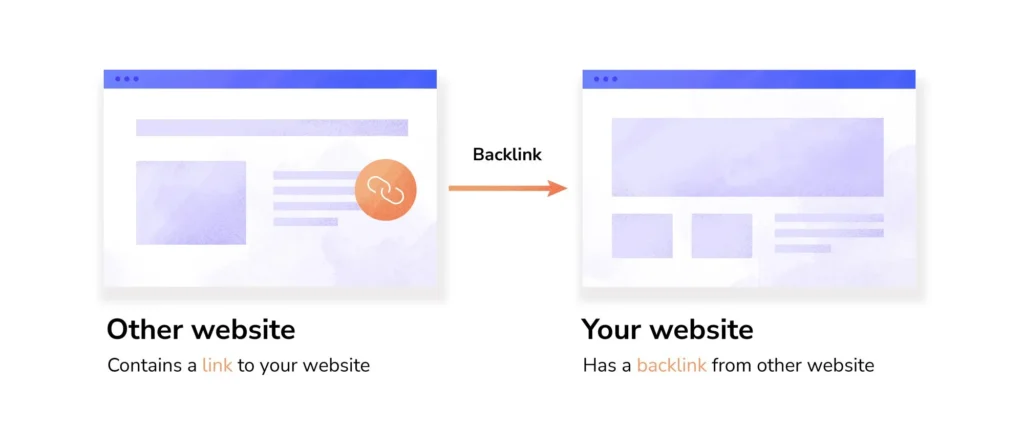
Source: SE Ranking
Search engines treat quality backlinks as trust signals because another website is effectively recommending your content.
However, not all backlinks carry the same value.
One relevant backlink from an authoritative industry website can outperform dozens of low-quality directory links.
For new websites, you should not focus on building the highest number of backlinks, but on earning relevant links that strengthen authority within your niche.
A practical link-building strategy usually starts with foundational links:
- Create and optimize business profiles on trusted platforms.
- Claim relevant local and industry directory listings.
- Build social media profiles and brand mentions.
- Ensure company information remains consistent across platforms.
Once foundations are in place, focus on earning links through valuable content. The most sustainable backlinks are often generated when other websites genuinely find your content useful.
Examples include:
- Original research and industry data
- Detailed guides and tutorials
- Statistics roundups
- Case studies and success stories
- Free tools, templates, or calculators
Guest posting can also be effective when done strategically.
Instead of targeting any website accepting guest posts, prioritize websites relevant to your industry and audience. A single contextual backlink from a niche-relevant website typically provides more value than multiple unrelated links.
When evaluating backlink opportunities, ask:
- Is the website relevant to my niche?
- Does it publish quality content?
- Would I want referral traffic from this website?
- Does the link provide value to readers?
If the answer is yes, it is usually a worthwhile opportunity.
Avoid creating backlinks such as:
- Buying large volumes of backlinks.
- Using private blog networks (PBNs).
- Automated link-building software.
- Spam comments and forum links.
- Low-quality link exchange schemes.
These tactics may create temporary gains but often lead to long-term SEO issues. A simple link-building checklist you can follow is:
- Create business and social profiles.
- Build citations and directory listings.
- Publish link-worthy content assets.
- Contribute guest posts to relevant websites.
- Monitor new backlinks through Google Search Console.
- Remove or disavow harmful links when necessary.
Keep one thing in mind that authority is not built overnight. Most successful websites earn trust gradually through consistent content, genuine mentions, and high-quality backlinks.
The stronger your authority becomes, the easier it’ll be for your website to rank competitively.
Step 8: Monitor and Improve SEO Performance
SEO does not end after publishing content, building links, or fixing technical issues. The websites that grow consistently are the ones that measure performance and improve based on data.
Without tracking, it becomes impossible to know what is working and what needs attention.
Start with Google Search Console and Google Analytics 4. Together, these tools provide most of the data needed to monitor a new website’s SEO performance.
Google Search Console shows how your website performs in search results. Google Analytics shows what users do after they arrive on your website.
Instead of tracking dozens of metrics, focus on the signals that directly impact growth.
Key SEO metrics to monitor:
- Organic clicks: How many visitors come from search results.
- Impressions: How often your pages appear in search.
- Average position: Where your pages rank for keywords.
- Click-through rate (CTR): How often users click after seeing your page.
- Indexed pages: How many pages Google has added to its index.
- Organic conversions: Leads, sales, or inquiries generated from SEO.
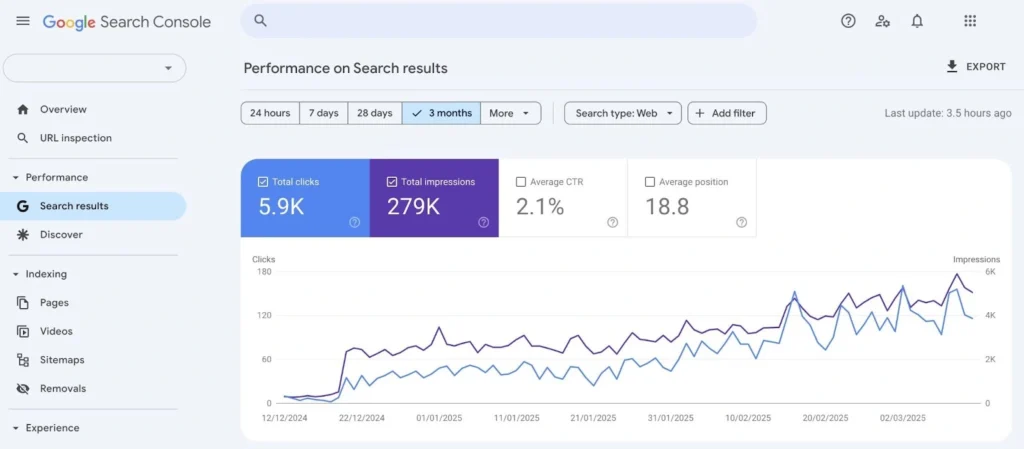
Regular SEO reviews help identify these opportunities before growth stalls. A simple monthly SEO review should include:
- Check Google Search Console for ranking and indexing changes.
- Review top-performing and declining pages.
- Identify new keyword opportunities.
- Fix crawl errors and indexing issues.
- Update outdated content.
- Monitor backlinks and brand mentions.
Many website owners focus only on rankings. However, rankings are a result, not the performance metric that matters most. The real objective is generating qualified traffic, leads, and business growth through organic search.
Here are some more useful tools to monitor SEO performance:
- Google Search Console
- Google Analytics 4
- Google PageSpeed Insights
- Google Trends
By this stage, you have the core SEO framework needed to grow a new website successfully.
Common SEO Mistakes New Websites Should Avoid
Many new websites fail to gain traction because they make avoidable SEO mistakes during the early stages.
The biggest mistake is targeting highly competitive keywords before building authority and topical relevance.
Another common issue is publishing content without a clear keyword or content strategy.
Many website owners also ignore internal linking, making it harder for search engines to understand page relationships.
Technical SEO mistakes can also limit visibility regardless of content quality. Therefore, avoid these common technical issues:
- Blocking important pages through robots.txt.
- Forgetting to submit an XML sitemap.
- Leaving noindex tags on important pages.
- Ignoring broken links and crawl errors.
- Not using HTTPS across the website.
Overall, the most common SEO mistakes to avoid are:
- Targeting highly competitive keywords too early.
- Publishing content without topical planning.
- Ignoring internal linking opportunities.
- Neglecting technical SEO fundamentals.
- Creating content that does not match search intent.
- Focusing only on traffic instead of conversions.
- Not tracking SEO performance regularly.
Avoiding these mistakes gives your website a much stronger foundation for long-term SEO growth.
Conclusion
Understanding how to do SEO for a new website is not about finding shortcuts or chasing quick rankings. It is about building the right foundation from day one.
By setting up your website correctly, targeting realistic keywords, creating valuable content, improving technical SEO, and earning quality backlinks, you give search engines more reasons to trust and rank your pages.
Just as importantly, modern SEO is no longer limited to traditional search engines. Strong content, clear structure, and topical authority also increase your visibility across AI-powered search experiences and LLMs.
The websites that succeed are usually not the ones publishing the most content. They are the ones consistently improving, measuring performance, and aligning every SEO effort with user intent.
Need help building an SEO strategy that drives rankings, traffic, and leads? Contact Codexxa today.
Add Comment