

Generative Engine Optimization (GEO): How It’s Changing SEO?
Search is no longer about ranking. It is about providing the right answer.
AI-powered engines like Google AI Overviews, ChatGPT, and Perplexity are now generating direct responses to user queries, bypassing traditional search results entirely. As of February 2026, Google AI Overviews now trigger on nearly 48% of all tracked search queries, which is a 58% increase year over year.
That is nearly half of all searches where your website may never even get seen.
This is where Generative Engine Optimization (GEO) becomes critical. It is the practice of optimizing your content so AI engines actively pull, reference, and cite your brand in generated answers.
In this blog, we break down what Generative Engine Optimization (GEO) is, how it works, and what your business needs to do right now to stay visible.
What is Generative Engine Optimization (GEO)?
Generative Engine Optimization (GEO) is the practice of optimizing digital content to be retrieved, cited, and surfaced by AI-powered search engines such as ChatGPT, Google AI Overviews, Perplexity, and Gemini when generating responses to user queries.
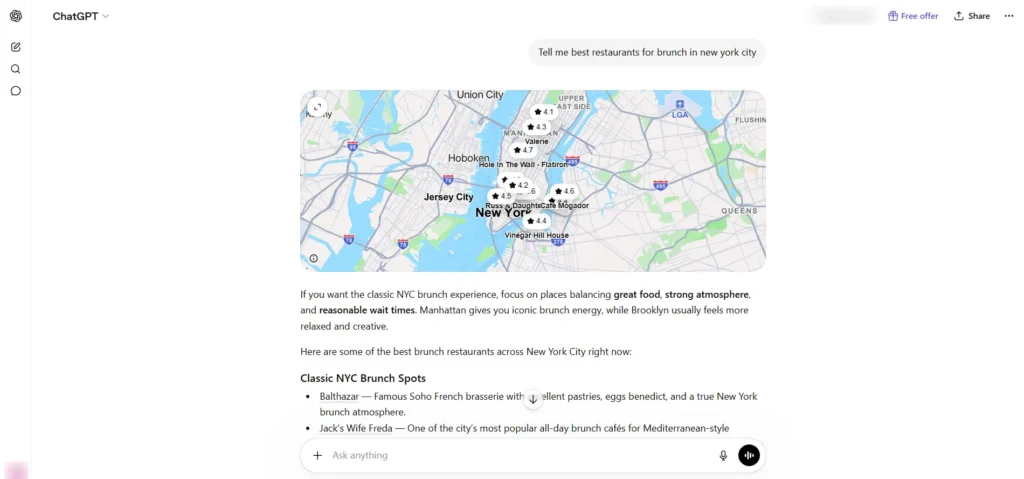
Unlike traditional SEO, which targets ranking positions on a results page, GEO targets citation placement inside an AI-generated answer, where only the most authoritative and well-structured sources get referenced.
The concept was formally introduced in November 2023 by a Princeton University-led research team, published at the ACM SIGKDD Conference. Their study tested fewer optimization strategies across 10,000 queries and delivered findings no marketer should ignore:
| GEO Strategy | Visibility Impact |
| Adding Statistics | +41% |
| Adding Expert Quotations | +28% |
| Citing External Sources | +115% (mid-ranked pages) |
| Keyword Stuffing | Actively reduces visibility |
AI engines do not reward frequency. They reward credibility, structure, and factual depth.
Your content either gets synthesized into the AI response, or it does not.
As of 2026, AI-referred sessions have surged 527% year-over-year. Brands getting cited inside AI responses are not just gaining visibility. They are capturing high-intent audiences at the exact moment a decision is being shaped.
How is GEO Different from Traditional SEO (GEO vs SEO)?
SEO and GEO share the same foundation: authoritative, well-structured content that answers user intent. But where they diverge is fundamental, and that divergence has direct consequences for how your business gets discovered in 2026.
Traditional SEO optimizes for ranking positions on a search results page. GEO optimizes for citation placement inside an AI-generated answer. These are two entirely different visibility models.
Here is exactly how they differ across every critical dimension:
| Comparison Area | Traditional SEO | Generative Engine Optimization (GEO) |
| Primary Goal | Rank on Google’s results page | Get cited inside AI-generated answers |
| Success Metric | Rankings, clicks, CTR | Citation rate, brand mentions, share of AI response |
| Content Focus | Keywords, backlinks, domain authority | Factual depth, structured clarity, E-E-A-T signals |
| Visibility Channel | Blue links on SERPs | ChatGPT, Perplexity, Google AI Overviews, Gemini |
| User Behavior | Click to website | Get answer directly, no click required |
| Optimization Target | Search engine crawlers | Large language models |
The data behind this shift is impossible to ignore.
According to BrightEdge’s primary research, only 17% of sources cited inside Google AI Overviews also rank in the organic top 10. That means 5 out of every 6 AI citations come from content that does not even appear on page one of traditional search results.
Ranking first no longer guarantees AI visibility. And AI visibility no longer requires ranking first.
This is the core tension every business needs to resolve in 2026. A brand can hold the top organic position and still be completely absent from the AI answer its target audience is reading. Conversely, a page sitting on position five or six can earn consistent AI citations if its content is structured, authoritative, and directly extractable.
The practical implication is this: SEO and GEO are not competing strategies. SEO builds the foundation. GEO builds visibility on top of it, specifically for the layer of search where buying decisions are increasingly being shaped.
How Generative AI Engines Works?
To optimize for generative AI engines, you first need to understand what happens the moment a user submits a query. It is fundamentally different from how Google’s traditional algorithm processes and ranks content.
There are three core mechanisms driving every AI-generated response:
1. Query Fan-Out
When a user submits a question, the AI does not run a single search. It immediately breaks that query into multiple parallel sub-queries, each targeting a different angle of the original question.
At Google I/O 2025, Google’s Head of Search Elizabeth Reid confirmed this directly:
“AI Mode uses our query fan-out technique, breaking down your question into subtopics and issuing a multitude of queries simultaneously on your behalf.”
For a standard query, Google’s AI Mode generates 8 to 12 sub-queries simultaneously. Its Deep Search feature can issue hundreds. This is precisely why ranking for one keyword no longer guarantees AI visibility. Your content must address multiple facets of a topic, not just a single search phrase.
2. Retrieval-Augmented Generation (RAG)
Once sub-queries are fired, the AI retrieves content using Retrieval-Augmented Generation (RAG). Here is exactly how that process unfolds:
| Step | What Happens |
| Crawl & Index | AI bots crawl web content and convert it into semantic embeddings stored in a vector database |
| Retrieval | The system searches for content semantically closest to each sub-query |
| Synthesis | Retrieved content from multiple sources is combined into one coherent response |
| Citation | Sources deemed most authoritative and extractable are cited inside the final answer |
3. Source Selection and Trust Signals
After retrieval, the AI selects which sources to cite. This decision is not based on traditional ranking signals. It is based on content-level trust signals that most businesses are not yet optimizing for:
- Factual depth and directness of answers.
- Presence of original statistics, citations, and expert quotations.
- Structured formatting that is easy to extract at passage level.
- E-E-A-T signals across the broader web, not just the page itself.
- Content freshness — 85% of AI Overview citations come from content published within the last two years, with 44% from 2025 alone.
The most important implication here is this: AI engines evaluate your content at the passage level, not the page level. A single well-structured, factually rich paragraph can earn a citation even if the overall page does not rank in Google’s top ten. That is a fundamentally different game from traditional SEO, and it requires a fundamentally different content approach.
Why Generative Engine Optimization (GEO) Matters for Your Business in 2026
AI search is no longer experimental. It is the default behavior for a growing majority of your target audience, and the business impact is now measurable, significant, and accelerating.
Here is what the data shows:
1. Organic CTR is Collapsing — And AI is the Reason
According to Seer Interactive’s study analyzing 3,119 informational queries across 42 organizations reveals that organic click-through rates for queries featuring Google AI Overviews dropped 61% since mid-2024, falling from 1.76% to 0.61%.
Even queries without AI Overviews declined 41% over the same period.
Users are not clicking less because your content got worse. They are getting their answers before they ever reach your website.
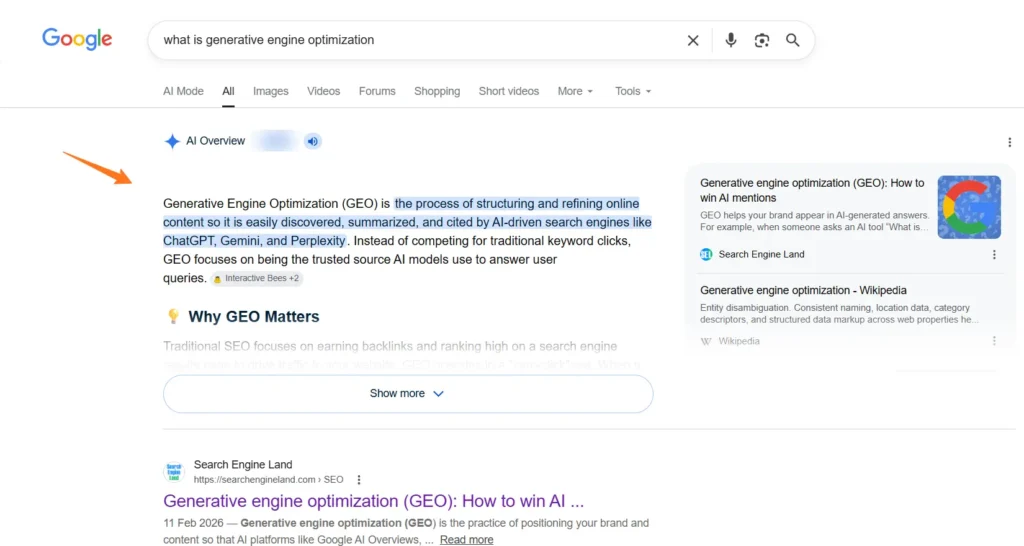
2. 60% of Searches Now End Without a Single Click
Zero-click search is no longer an edge case. It is the majority behavior. For queries where an AI Mode response appears, that figure reaches 93%.
Your content is being read by AI engines and summarized for users. The question is whether your brand is the one being cited, or your competitor’s.
3. Being Cited Changes Everything
This is where GEO shifts from a defensive play to a genuine growth lever. Brands that are cited inside AI Overviews earn 35% more organic clicks and 91% more paid clicks compared to non-cited competitors ranking for the exact same queries.
AI-referred traffic also converts at 14.2% compared to Google organic’s 2.8%.
The gap between cited and non-cited brands is not just a visibility gap. It is a revenue gap.
4. The Window to Act is Narrowing
Nearly 40% of decision-makers now allocate dedicated budget for AI search optimization. Brands that establish citation authority now are building a compounding advantage that becomes significantly harder to close the longer competitors wait.
GEO is not a trend to monitor. It is an operational priority that is already separating high-visibility brands from invisible ones, in your category, right now.
AI search visibility is no longer optional for growing businesses. Let Codexxa’s AI Search Optimization Services position your brand where your audience is already finding answers.
Core Pillars of a Strong GEO Strategy
GEO is not a single tactic. It is a way that is built across multiple interconnected pillars, each of which signals to AI engines that your content is authoritative, extractable, and worth citing.
According to Princeton’s research published at ACM SIGKDD, applying these techniques in combination can improve AI visibility by up to 40% in generative engine responses.
Here are the pillars every serious GEO strategy must be built on:
1. Direct and Structured Content
AI engines evaluate content at the passage level, not the page level. Every section must stand alone as a complete, extractable answer.
Lead each section with a direct response, use clear headings, and avoid dense paragraphs that bury the core answer inside supporting detail.
2. Factual Depth with Cited Data
AI engines prioritize content that is verifiable. Every major claim should be supported by a named source, a specific figure, or an attributable expert quotation. Generic assertions without evidence are consistently deprioritized in AI-generated responses.
3. E-E-A-T Signals Across the Entire Web
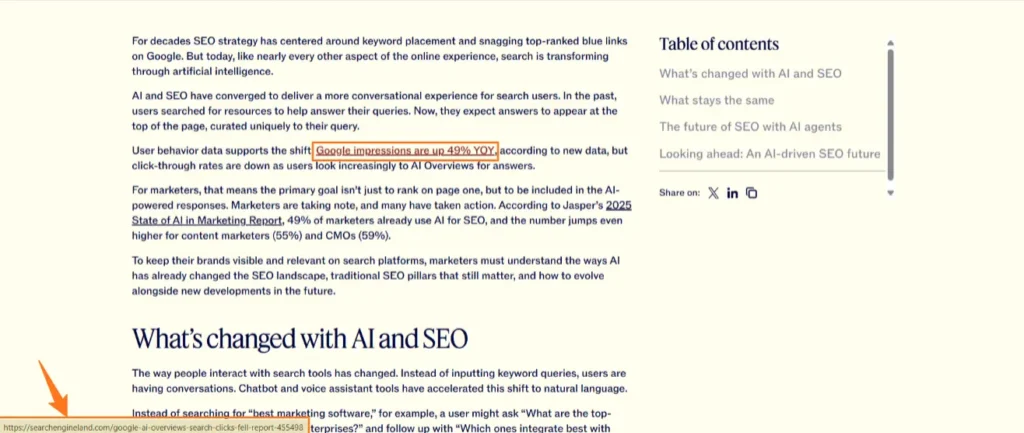
AI engines assess your brand’s authority across the broader web, including third-party mentions, citations from authoritative domains, author credentials, and consistency of expertise across published content.
Your off-page presence, PR mentions, industry citations, and author authority all directly influence whether AI engines trust your content enough to cite it.
4. Content Freshness and Regular Updates
AI engines show a documented preference for recently updated content. A quarterly refresh cycle for core pages, with clearly visible last-updated dates and current data, is now a baseline GEO requirement, not an optional improvement.
5. Technical Infrastructure for AI Crawlability
If AI crawlers cannot access your content, none of the above matters. Schema markup, structured data, clean site architecture, and ensuring AI bots are not blocked in your robots.txt are foundational requirements.
Structured data helps AI engines parse your content faster and more accurately, directly improving citation likelihood across ChatGPT, Perplexity, and Google AI Overviews.
6. Off-Site Brand Authority
AI engines build a picture of your brand from across the entire web. Consistent mentions on authoritative platforms, guest contributions on industry publications, podcast appearances, and Wikipedia or Wikidata presence all contribute to entity authority signals that determine citation frequency.
47% of brands currently have no GEO strategy in place. The brands investing in off-site authority now are building citation dominance that compounds over time.
Common GEO Mistakes Businesses Are Already Making
Most businesses stepping into generative engine optimization are making the same errors. Unlike traditional SEO, where a ranking drop tells you something went wrong, but in GEO, it’s completely silent. Your AI citation rate drops, and you never see it happening.
Here are the mistakes that are costing businesses the most right now:
1. Applying Old SEO Habits to GEO
Stuffing keywords and chasing backlinks does not work in AI search optimization. AI engines do not rank pages. They read passages and pick the ones that are clear, factual, and trustworthy.
A competitor with a shorter, well-structured article that cites real data will get cited over your 3,000-word keyword-heavy page every single time.
2. Accidentally Blocking AI Crawlers
Most businesses do not know this is happening to them.
Cloudflare recently changed its default settings to block AI bots. If your site runs on Cloudflare and you have not checked this, crawlers from ChatGPT, Perplexity, and Google AI Mode may already be blocked from reading your content.
Go to your robots.txt file right now. Search for ChatGPT-User and OAI-SearchBot. If they are blocked, you are invisible to AI search, no matter how good your content is.
3. Writing About Everything But Owning Nothing
47% of brands are failing at GEO, and one of the biggest reasons is having no real topical focus.
AI engines look for sources that clearly know what it’s about. A business with 80 thin articles across 20 different topics signals nothing. A business with 20 in-depth articles built around one focused area becomes the source AI engines keep coming back to.
Pick your core topic area. Go deep on it. That is how you earn consistent AI citations.
4. Focusing Only on Your Own Website
On-page content alone will not get you cited. AI engines pull from across the web, and they consistently favor third-party sources over brand-owned content.
If your brand has no presence in industry publications, no expert mentions, and no coverage outside your own site, AI engines simply do not have enough signals to trust you. Getting mentioned in the right places, by the right sources, is as important as anything you publish on your own domain.
5. Never Checking What AI Says About You
Most businesses have never tested how ChatGPT or Perplexity describes them. That is a real problem.
AI engines can get your positioning wrong, surface outdated information, or describe your services inaccurately. And if you are not checking, that narrative is being read by potential buyers before they ever reach your website.
Open ChatGPT right now. Type in your business name or your core service. Read what comes back. That is your starting point for fixing your GEO visibility.
6. Doing It Once and Moving On
AI models update regularly. What earns citations today may not work after the next model update or after a competitor refreshes their content strategy.
Businesses that treat AI search optimization as a one-time project consistently fall behind those running quarterly content audits and keeping their authority signals fresh. GEO is not a task you complete. It is something you maintain.
Also Read:
- 9+ Best Digital Marketing Strategies for Small Businesses
- 12 Powerful AI Tools for Digital Marketing in 2026
Conclusion
Search has already shifted. AI engines are now where buying decisions start, and Generative Engine Optimization (GEO) determines whether your brand is part of those answers or invisible to them.
Here is what you need to take away from this blog:
- GEO and SEO work together, not against each other.
- AI engines reward factual depth, structure, and credibility, not keyword frequency.
- Being cited inside an AI response drives higher intent traffic than a first-page ranking.
- Mistakes like blocking AI crawlers or thin content are silently killing visibility right now.
- Tools like Profound, Otterly AI, SE Ranking, and Airefs can help you track and improve your AI citation rate.
The brands investing in AI search optimization today will be the ones dominating their category tomorrow.
If you want Codexxa to build that visibility for your brand, let’s talk.
FAQs about Generative Engine Optimization (GEO)
1. What is Generative Engine Optimization (GEO)?
GEO is the practice of optimizing your content so AI-powered search engines like ChatGPT, Perplexity, and Google AI Overviews retrieve, cite, and reference your brand inside their generated responses.
2. Will GEO Replace SEO?
No. GEO builds on top of SEO. Traditional SEO gets you ranked. GEO gets you cited inside AI answers. Both are needed for complete search visibility in 2026.
3. What is the Difference Between GEO vs AEO vs SEO?
SEO targets search engine rankings. AEO (Answer Engine Optimization) focuses on featured snippets and voice search. GEO specifically optimizes for AI-generated responses across platforms like ChatGPT, Gemini, and Perplexity.
4. What Are the Generative Engine Optimization Best Practices?
1. Use cited data and statistics.
2. Structure content for passage-level extraction.
3. Build off-site brand authority.
4. Keep content fresh and updated regularly.
5. Ensure AI crawlers are not blocked.
5. What Are the Best Generative Engine Optimization Tools?
Top tools include Profound, Otterly AI, SE Ranking, and Airefs. For a free starting point, manually test your brand queries directly inside ChatGPT, Perplexity, and Gemini.
Add Comment