
AI Shopping in ChatGPT & Google: How to Get Your Products Found
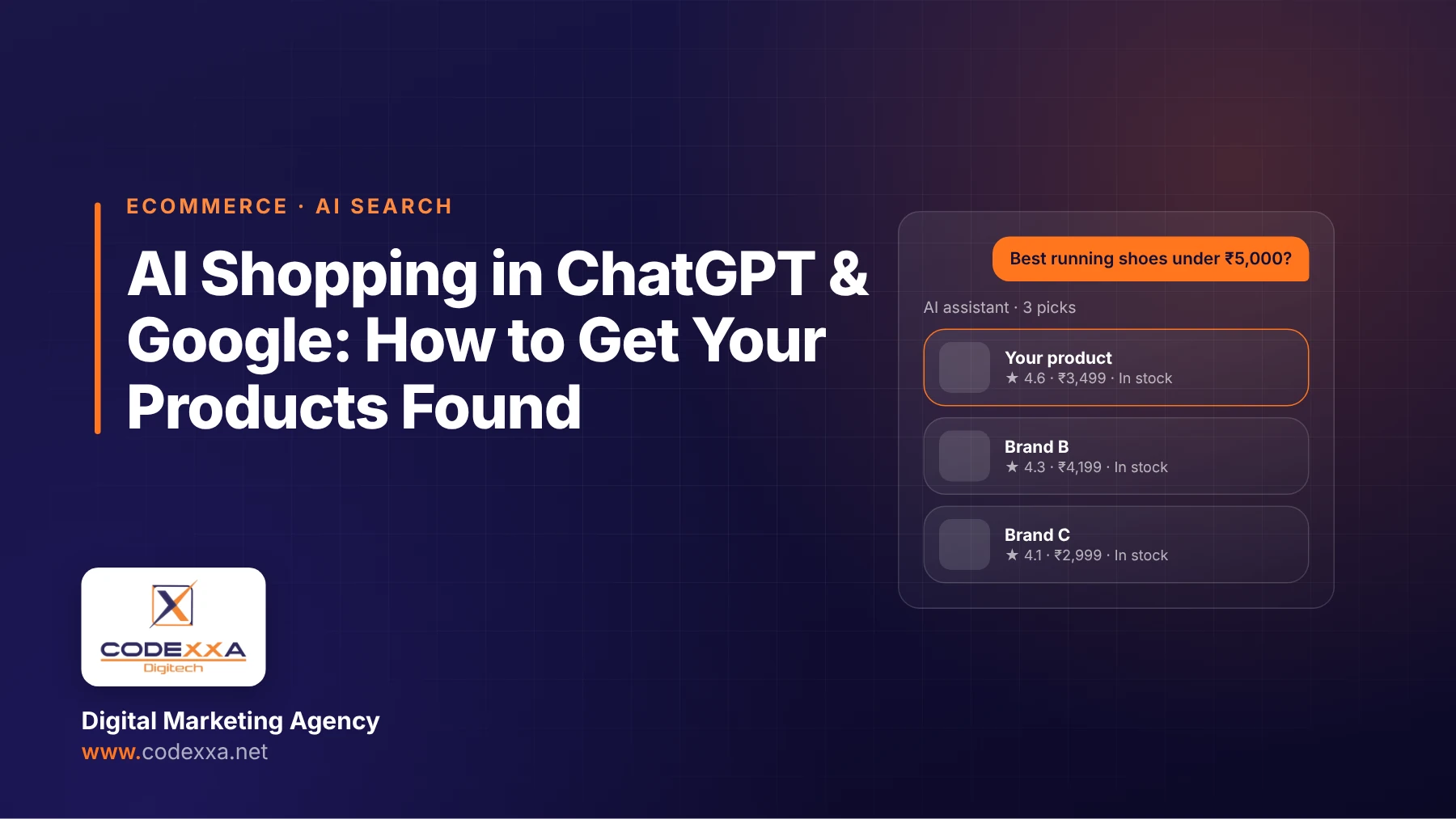
Shoppers are starting to ask AI assistants what to buy. Instead of typing “running shoes” into a search bar and opening ten tabs, they ask ChatGPT or Google’s AI Mode, “What are the best running shoes under ₹5,000 for flat feet?”, and get a short list of products with prices, reviews and links.
If your products are not in that list, you are invisible at the exact moment someone is ready to buy. This guide explains how ChatGPT Shopping and Google’s AI shopping work in late 2026, what has changed recently, and the practical steps Indian ecommerce and D2C brands should take now.
What is AI shopping?
AI shopping is product discovery inside AI assistants. The assistant understands a shopper’s question, compares products using merchant data and public information, and recommends a few options. The two that matter most right now are ChatGPT Shopping and Google’s AI Mode (along with AI Overviews and Gemini).
ChatGPT Shopping in late 2026: what changed
OpenAI launched Instant Checkout in September 2025, letting some US shoppers buy from Etsy and Shopify sellers without leaving ChatGPT. According to SellerAI, OpenAI retired Instant Checkout on 24 March 2026, saying the first version “did not offer the level of flexibility” it wanted.
ChatGPT Shopping did not disappear. It now focuses on discovery: visual product results, side-by-side comparisons, image search and follow-up questions, available to free and paid users. When a shopper is ready to buy, they click through and check out on the retailer’s own website.
For merchants, this is good news. You keep the customer relationship and the checkout, but you need your product data to be strong enough for ChatGPT Shopping to pick you.
How ChatGPT Shopping and Google choose which products to show
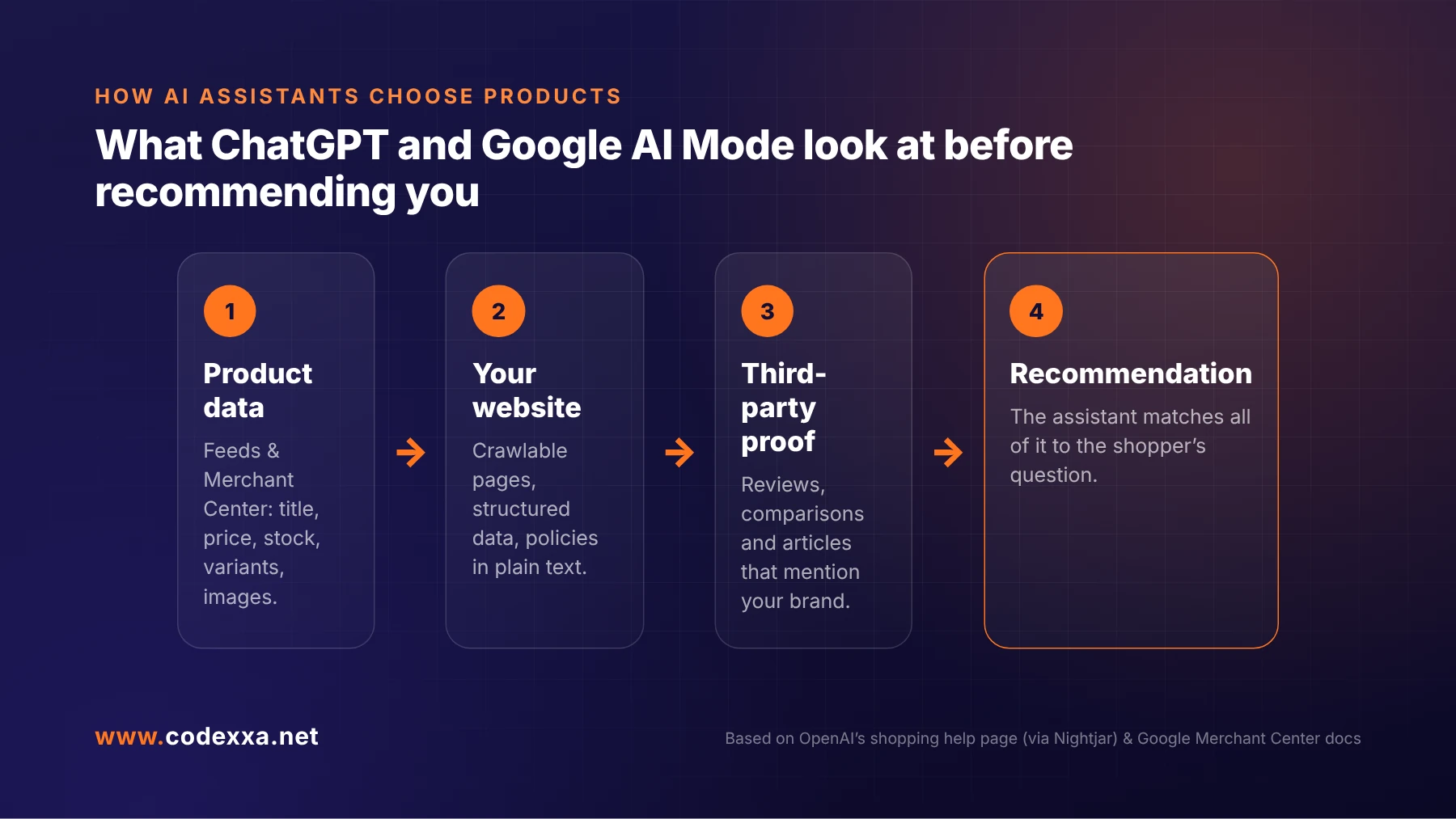
According to OpenAI’s shopping help page, as quoted by Nightjar, ChatGPT matches the shopper’s question and context with structured merchant data, third-party content, price and reviews. When choosing between sellers it looks at availability, price, quality and whether the seller is the maker or primary seller. OpenAI says ChatGPT Shopping results are not ads and are not influenced by partnerships. Ads that OpenAI has tested are labelled and shown separately.
Product feeds have become much more important for ChatGPT Shopping. Tracking data cited by SellerAI and Nightjar suggests the share of ChatGPT product recommendations coming from merchant feeds jumped from under one in ten to around two-thirds after a July 2026 change.
Google AI Mode works in a similar way, but its main source is Google Merchant Center plus the pages Google crawls. If your products are in Merchant Center with free listings enabled, you are already eligible to appear in Google’s AI shopping experiences.
Is AI shopping available in India?
- ChatGPT Shopping: the sources we reviewed describe it as live for US users, with expansion planned. Indian brands that sell to US customers can benefit today. Brands that only sell in India should prepare now so they are ready when it expands.
- Google: Merchant Center product data already powers Google Shopping in India, and Google’s Merchant Center AI performance insights cover accounts in India for English queries.
- New checkout standards: Google and Shopify are the lead developers of the Universal Commerce Protocol (UCP), announced in January 2026. Flipkart is listed among its endorsers, but in-chat checkout is still US-first.
How to get your products into ChatGPT Shopping
- Shopify stores: eligible stores are already connected through Shopify Catalog. Make sure your products have titles, images and prices, and that your shipping and return policies are filled in under Settings → Policies.
- Allow ChatGPT’s crawler: check that
OAI-SearchBotis not blocked in yourrobots.txt. Changes can take about 24 hours to be picked up. - Apply as a merchant: other platforms can apply at chatgpt.com/merchants to share a product feed. Feed onboarding is for approved partners and has a waitlist.
- Prepare a clean feed: OpenAI’s spec requires fields such as item ID, title, description, URL, brand, seller name, image URL, availability and price for every variant, refreshed daily.
How to show up in Google AI Mode
- Set up Google Merchant Center and switch on free listings.
- Add shipping settings and a return policy. Free listings need both.
- If you use Shopify, connect the Google & YouTube app so products sync automatically.
- Add optional attributes that help conversational answers, such as product highlights, questions and answers, and related products.
- Keep product structured data (schema) on your product pages consistent with your feed.
ChatGPT Shopping checklist: 10 things to fix first
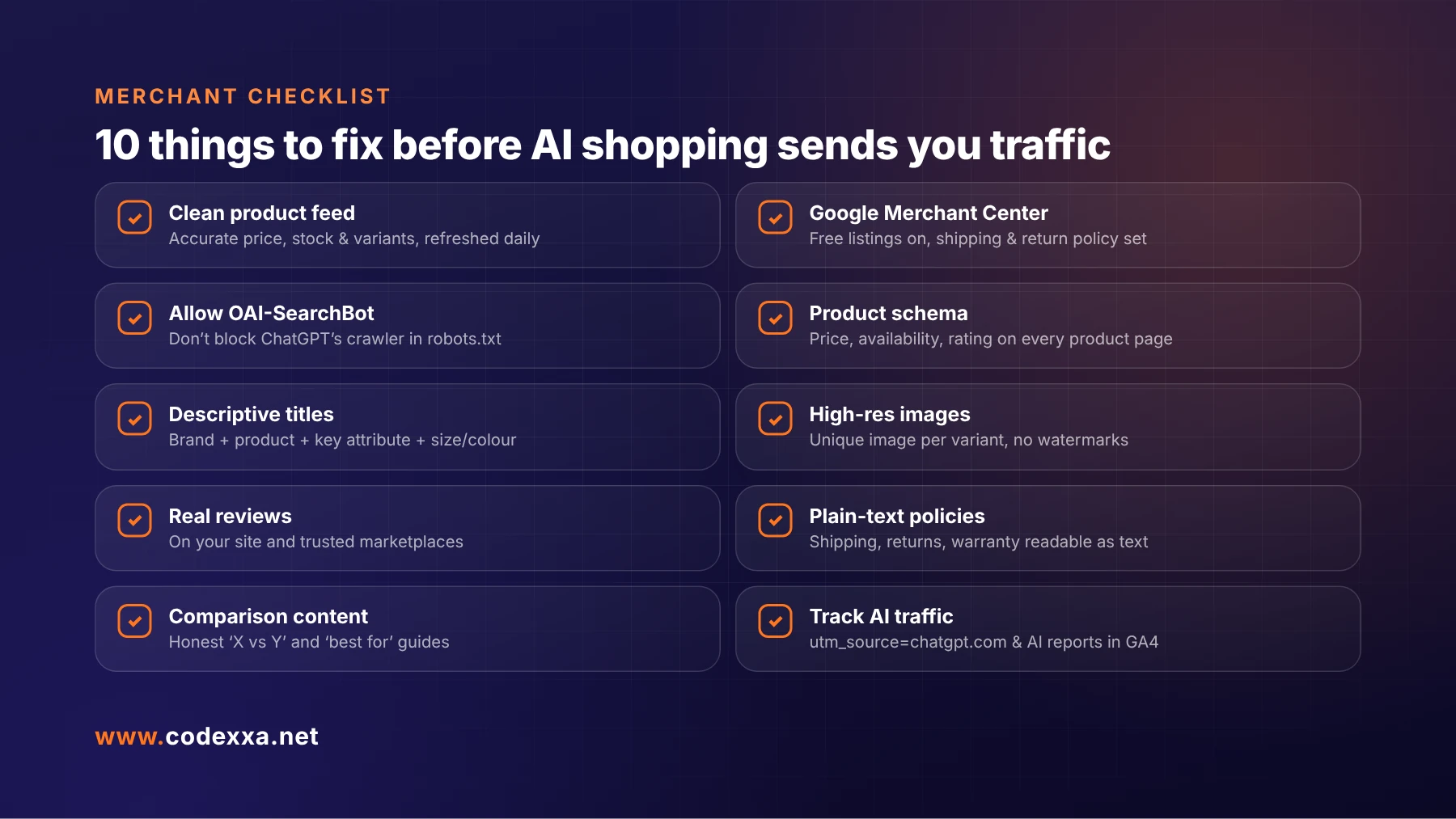
- Accurate feed data: price, stock and variants refreshed at least daily. Stale data gets ignored or shown wrongly.
- Descriptive titles: brand + product type + key attribute + size or colour, the words shoppers actually ask with.
- Detailed descriptions: who the product is for, materials, sizing and use cases, written for humans.
- High-quality images: a unique image per variant, no watermarks. Google will require main images of at least 500×500 px from 31 January 2027 and recommends 1500×1500 px.
- Product schema with price, availability and ratings on every product page.
- Real reviews on your site and trusted marketplaces. AI summaries are built from public reviews.
- Policies in plain text: shipping, returns and warranty should be readable text, not images or pop-ups.
- Comparison content: honest “X vs Y” and “best for” guides help assistants explain trade-offs.
- Third-party mentions: features in reviews, roundups and press help AI trust your brand.
- Measure AI traffic: track visits from
utm_source=chatgpt.comin GA4 and use Merchant Center’s AI performance report.
Note that Google has said it ignores llms.txt files. Good SEO, structured data and clean feeds matter far more.
How AI shopping fits into your ecommerce SEO
ChatGPT Shopping is not a separate channel you can switch on. It is the result of the same fundamentals: crawlable pages, strong product data, genuine reviews and helpful content. Brands that already do ecommerce SEO audits and keep their marketplace listings sharp, like our Amazon listing optimisation tips suggest, are already most of the way there. Our guide to Generative Engine Optimization (GEO) covers the content side of AI visibility.
Want help preparing your store? Our ecommerce marketing team can audit your feed, schema and product pages for AI shopping. Book a free audit.
Frequently asked questions
How do I get my products listed on ChatGPT?
Shopify and Etsy stores that are eligible are already integrated. Other stores should allow OAI-SearchBot in robots.txt, keep product pages crawlable, and apply to share a product feed at chatgpt.com/merchants.
Does ChatGPT charge sellers for shopping?
According to the sources we reviewed, there are no fees on purchases that start in ChatGPT and complete on your website. Separate, labelled ads are being tested.
Is ChatGPT Instant Checkout still available?
No. It was retired in March 2026. ChatGPT now sends shoppers to the retailer’s website to complete the purchase.
How do products appear in Google AI Mode?
Google uses Merchant Center product data and the pages it crawls. Set up Merchant Center, enable free listings, add shipping and return policies, and keep your feed accurate.
Is ChatGPT Shopping live in India?
The sources we reviewed describe it as live for US users with expansion planned. Indian brands should prepare their feeds and product pages now, and can already benefit through Google.

Sam K
Sam K is a brand growth marketer with 8 years of experience helping D2C, ecommerce and B2B brands grow through performance marketing, SEO, content and influencer campaigns. At Codexxa, Sam writes practical, data-backed guides on the strategies that turn marketing spend into measurable brand growth.
Related posts
Meta Andromeda Explained: How to Structure Meta Ads & Creatives in 2027
Meta Andromeda changed how Facebook and Instagram ads are delivered. Here is how to structure campai...
How to Turn Text Into Marketing Videos Using AI
Learn how to turn text into marketing videos using AI, with a 6-step process, three AI tools (invide...
Add Comment