
Meta Andromeda Explained: How to Structure Meta Ads & Creatives in 2027
If your Meta ads suddenly felt less predictable over the last year, with interest stacks that stopped working, lookalikes that lost their edge, and winning ads that burned out faster, you are not imagining it. Meta has changed how it decides which ads to show, and the change has a name: Andromeda.
This guide explains what Meta Andromeda is in plain language, how it works with Meta’s GEM ranking model, and exactly how to restructure your campaigns and creatives so the system works for you instead of against you. If you run ads for a D2C brand, an ecommerce store or a lead-generation business in India, this is the playbook we recommend for 2027.
What is Meta Andromeda?
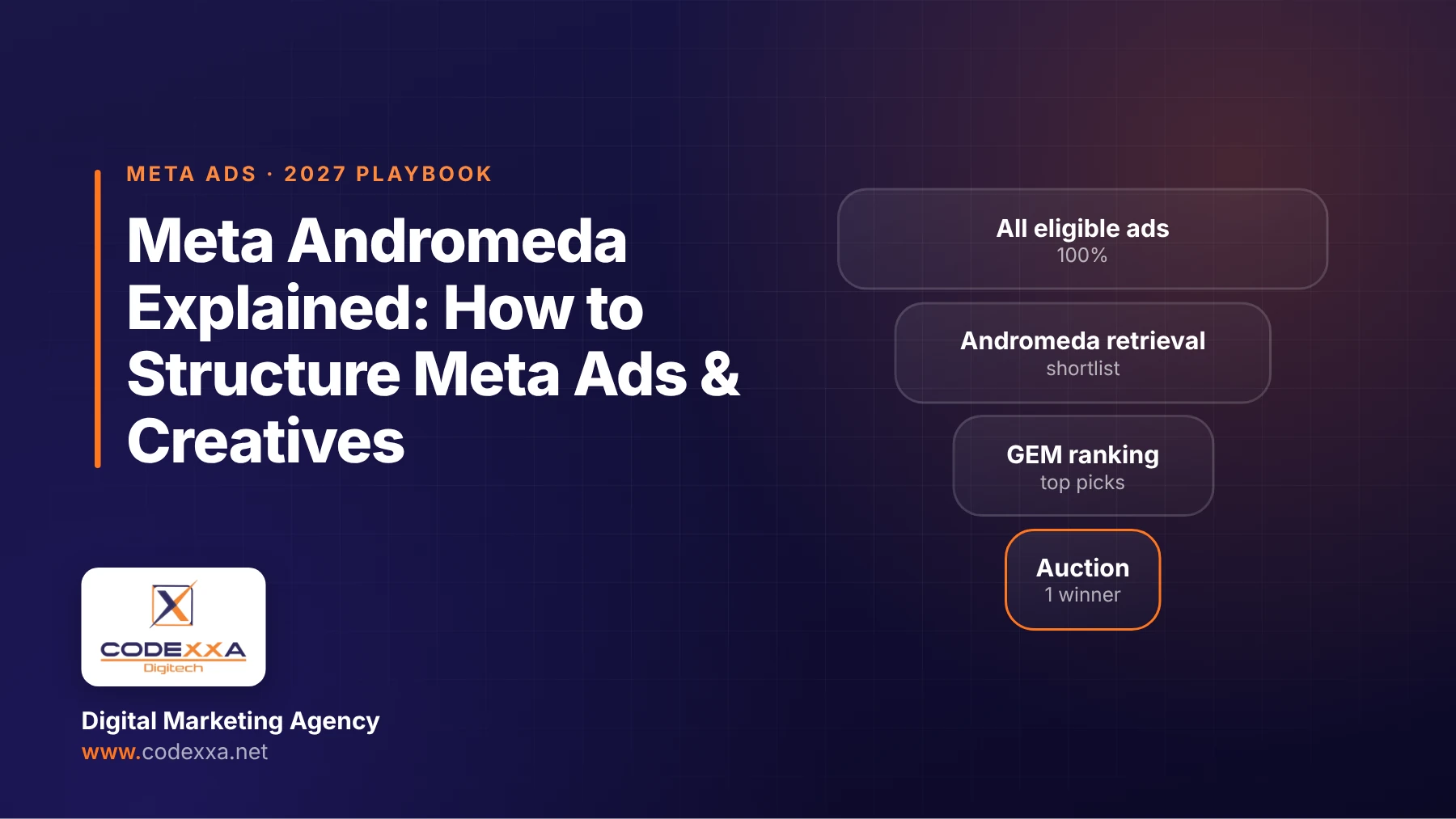
Andromeda is Meta’s AI-driven ad retrieval system. Before any auction happens, Meta has to narrow millions of possible ads down to a small shortlist that might be relevant to one person at one moment. Andromeda does that shortlisting.
According to Search Engine Land, Andromeda began rolling out in late 2024 and became a core part of Meta’s delivery system through 2025. It works alongside GEM (Generative Ads Recommendation Model), which began rolling out in mid-2025 and feeds its predictions into the system. Meta has described GEM as four times more efficient at driving ad performance gains than its earlier ranking models.
The important part for advertisers: Andromeda does not replace the auction, your bids or your campaign settings. It changes which ads even get a chance to compete. And it makes that decision by reading your creative itself, not just the audience you selected.
How Meta now decides which ad to show
Ad delivery on Facebook and Instagram now happens in two broad phases: retrieval, then ranking. Here is the simplified journey every impression goes through.
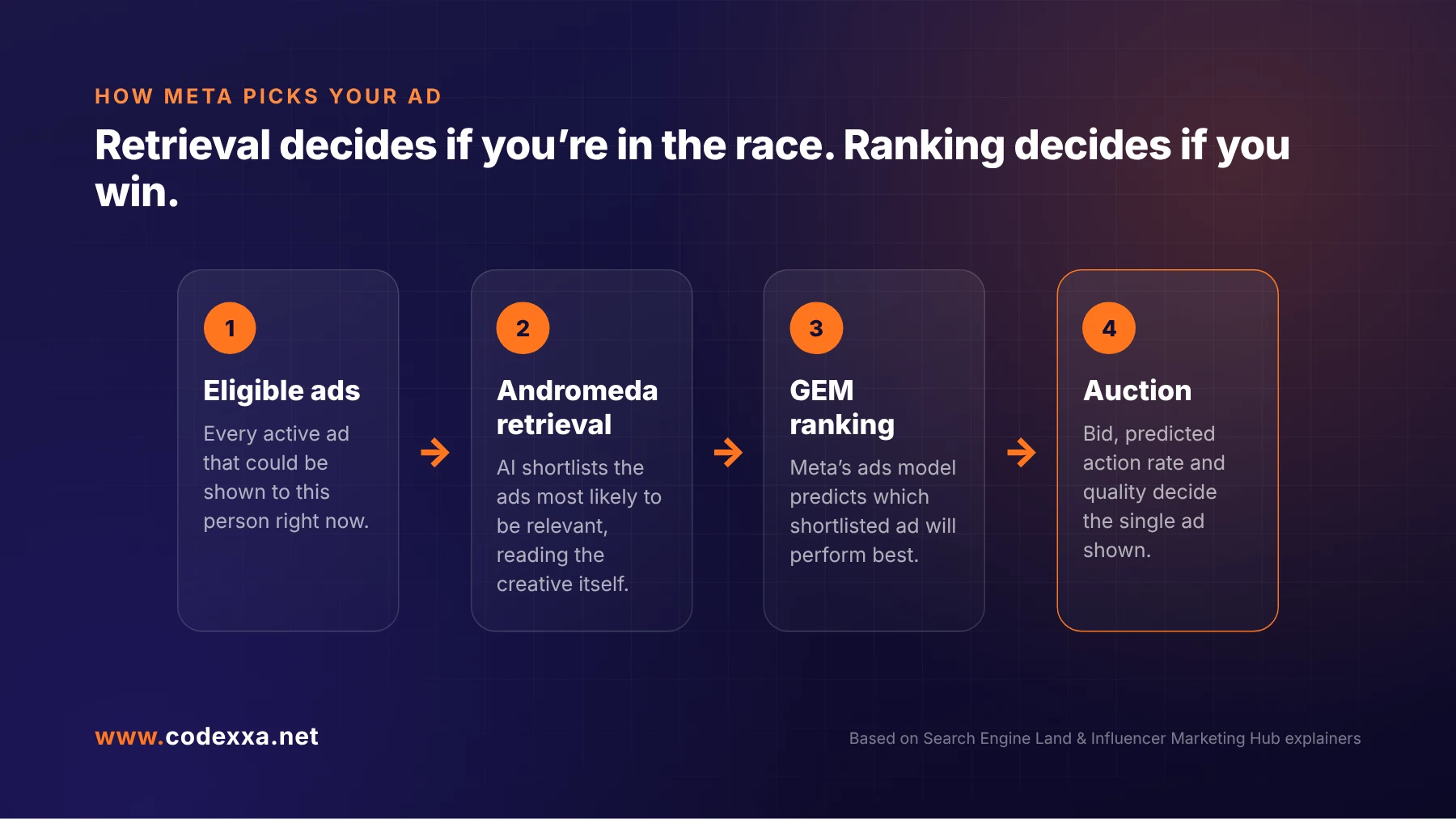
- Eligible ads: every active ad that could legally be shown to this person.
- Andromeda retrieval: the AI shortlists the ads most likely to be relevant, using signals from the creative (visuals, copy, format, tone) and the person’s behaviour.
- GEM ranking: Meta’s ranking models predict which of the shortlisted ads is most likely to drive the result you optimise for.
- Auction: your bid, the predicted action rate and ad quality decide the single ad that wins.
This is why marketers describe the shift as moving from audience-first to creative-first. Your creative now does much of the targeting work that interests and lookalikes used to do. If you only give Meta a handful of near-identical ads, Andromeda has very little to work with.
What changed for advertisers
- Narrow targeting matters less. Search Engine Land notes that interest and lookalike audiences “no longer performed as strongly” after the change.
- Creative variety matters more. Dentsu’s guidance is blunt: duplicating ads with small edits “is no longer enough”. Andromeda reads attributes such as tone, visual style and messaging, so similar ads compete for the same slot.
- Early delivery is more volatile. Influencer Marketing Hub points out that performance swings are more common in the first days of a campaign, which tempts advertisers to make changes too soon.
- Automation is the default. Advantage+ campaigns rely on broad targeting, high creative diversity and automated decisions, which is exactly what Andromeda is designed for.
How to structure Meta ad campaigns for Andromeda
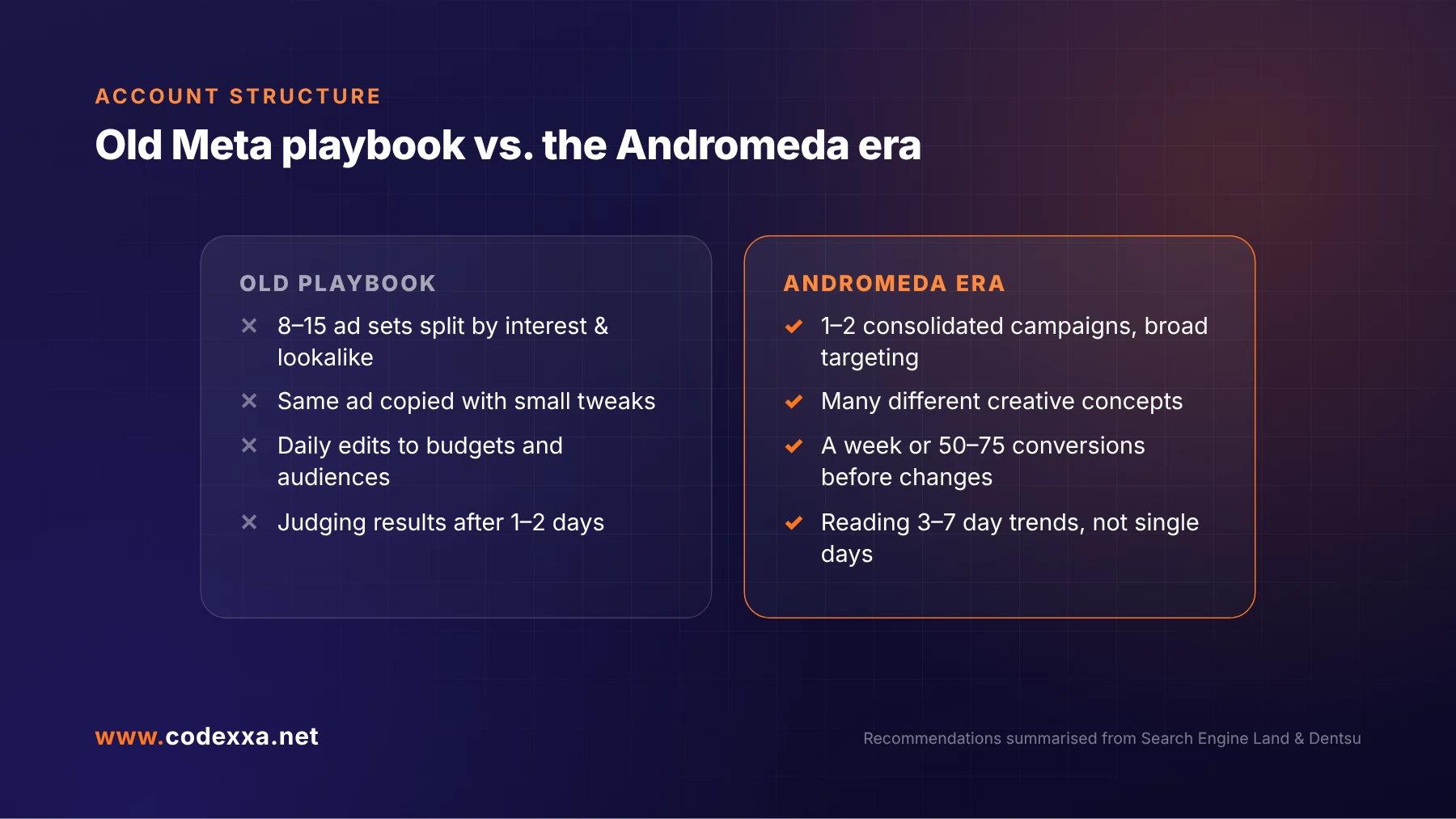
The biggest mistake we see in Indian ad accounts is a structure built for 2021: ten or more ad sets, each with a different interest stack, each with too little budget to exit learning. Here is how the playbook has changed.
1. Consolidate campaigns and ad sets
Fewer campaigns with larger budgets give the system more data per decision. Search Engine Land notes that in many accounts it is now typical to run only one or two campaigns per objective. A practical structure for most D2C brands:
- One prospecting campaign (Advantage+ sales or a manual sales campaign with broad targeting).
- One retargeting or customer campaign only if you have enough volume. Otherwise let Advantage+ handle existing customers with its audience controls.
- One testing campaign (optional) with a fixed share of budget, typically 10–20%, for new creative concepts before they graduate to the main campaign.
2. Go broad, and let the creative target
Remove stacked interests and heavy exclusions in prospecting. Use location, age where it is truly required, and let the creative attract the right buyer. A skincare ad featuring a 40-plus customer talking about fine lines will find a different audience from a reel about acne in college, even with identical targeting.
3. Respect the learning window
Search Engine Land recommends a minimum “no-touch” window of a week or 50–75 conversions, whichever comes first, and judging 3–7 day trends rather than daily swings. Every budget jump, audience edit or new ad set resets what the system has learned.
4. Feed the system clean conversion data
Andromeda and GEM optimise for the signal you send. Set up the Conversions API alongside the Pixel, send purchase value, and deduplicate events. If you sell offline or through WhatsApp, upload qualified leads or sales back to Meta so it learns what a good customer looks like, not just a cheap form fill.
Creative diversity: the new targeting
“More creatives” does not mean twenty versions of the same video with different colours. Diversity means different concepts: different people, problems, angles, hooks and formats. A useful way to plan it is a concept-by-format matrix.
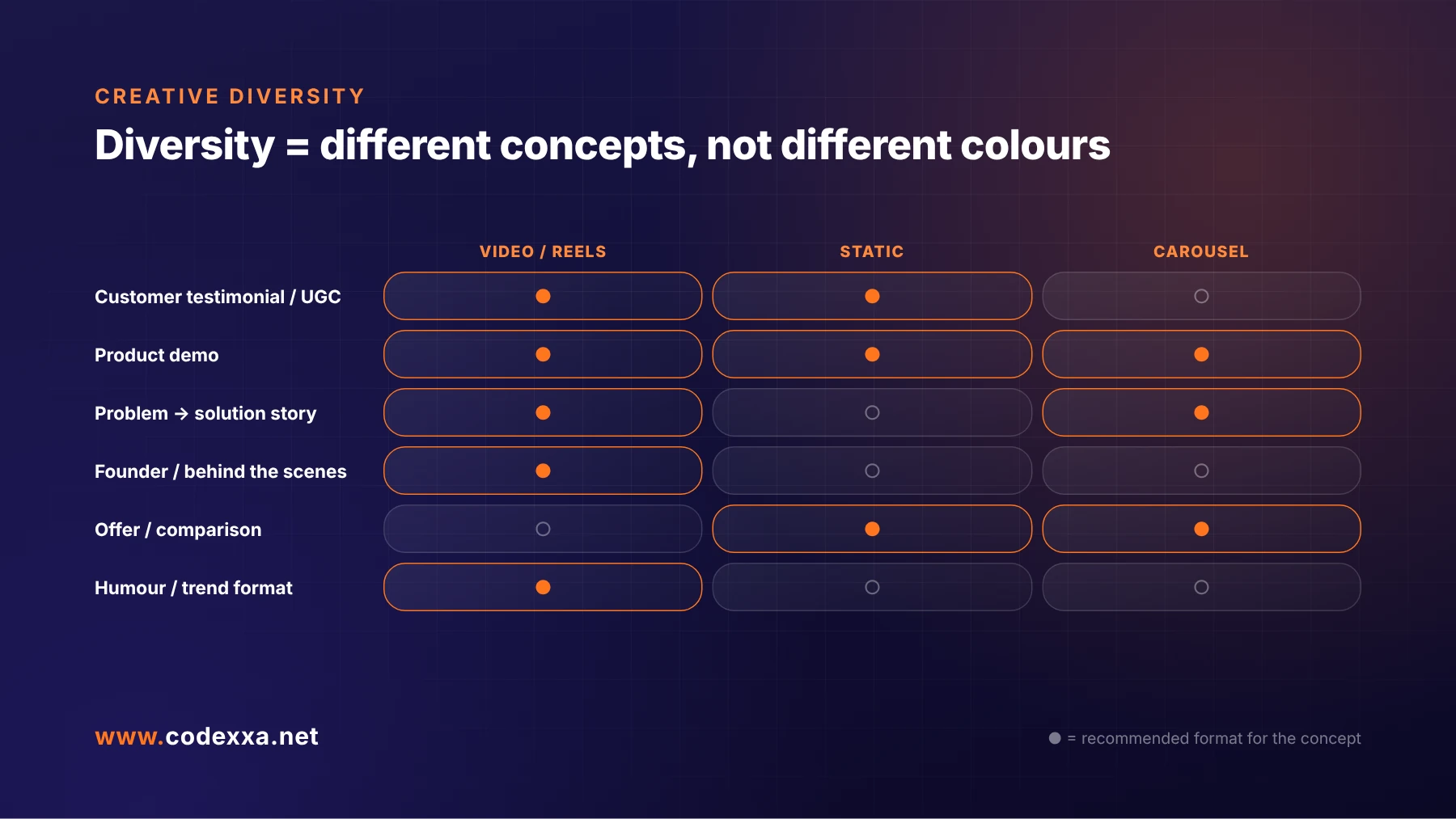
Creative concepts worth testing
- Customer testimonials and UGC: real customers explaining the result in their own words.
- Product demos: show the product solving the problem in the first three seconds.
- Problem-to-solution stories: start with the pain point your buyer recognises.
- Founder or behind-the-scenes: builds trust, especially for new D2C brands.
- Offer and comparison ads: price, bundle or “us vs. the usual option”.
- Trend and humour formats: native-looking reels that do not feel like ads.
Audit your creative library by concept, not by format, as Influencer Marketing Hub suggests. If 80% of your ads are the same product shot with different headlines, you have one concept, not twenty ads. Aim to launch new concepts every week or two rather than new variations every day. Our ad creative team plans creative in exactly this way.
What is new on Meta in late 2026
Meta keeps layering AI on top of Andromeda. A few updates reported in recent weeks (summarised by eCorpIT, citing Meta’s Help Centre and trade press) are worth checking in your account:
- Product browsing was reportedly switched on for existing Facebook and Instagram ads from 28 October 2026. You can review it per ad in the Advantage+ creative settings.
- Meta’s AI assistant in Ads Manager gained creative insights in October 2026. Meta says advertisers who adopt its recommendations see 5% more conversions at the same cost per conversion, compared with those who do not.
- On-device conversion measurement is rolling out by default for eligible pixels, so re-check your attribution numbers if they move suddenly.
Common mistakes to avoid
- Splitting a small budget across many ad sets so none of them exits learning.
- Killing campaigns after one or two expensive days.
- Testing “variations” (button colour, headline word) instead of new concepts.
- Optimising for cheap leads without sending lead quality back to Meta.
- Leaving Advantage+ creative enhancements and new defaults unchecked after a platform update.
Your Andromeda checklist
- Merge overlapping prospecting ad sets into one broad campaign.
- Set up the Conversions API and send purchase value or qualified-lead events.
- Build a concept matrix and launch at least four to six genuinely different concepts.
- Hold changes for a week or 50–75 conversions.
- Review results on 3–7 day trends and refresh concepts every one to two weeks.
- Re-check new Advantage+ defaults after every Meta announcement.
If you want a second pair of eyes on your account, our Meta Ads team can audit your structure and creative mix. You can also read our guides on running a Facebook Ads audit and improving ROAS.
Frequently asked questions
What is Meta Andromeda in simple words?
It is the AI system Meta uses to shortlist which ads are relevant to a person before the auction. It reads your creative to understand who it is for, so your creative now plays a big role in targeting.
Do interest audiences still work after Andromeda?
They can still be used, but most advertisers see better results with broad targeting and strong creative diversity. Interests are now better treated as a test, not the default structure.
How many creatives should I run per ad set?
Meta does not publish a fixed number. Focus on the number of distinct concepts rather than total ads. Four to six clearly different concepts, each in a couple of formats, is a sensible starting point for most Indian D2C budgets.
Is Advantage+ better than manual campaigns now?
Advantage+ is built for how Andromeda works, so it is often the strongest option for ecommerce sales. Manual campaigns are still useful when you need tighter control, for example for lead quality or specific regions.
How long should I wait before changing a Meta campaign?
A good rule is one week or 50–75 conversions, whichever comes first, and then judge on 3–7 day trends.

Sam K
Sam K is a brand growth marketer with 8 years of experience helping D2C, ecommerce and B2B brands grow through performance marketing, SEO, content and influencer campaigns. At Codexxa, Sam writes practical, data-backed guides on the strategies that turn marketing spend into measurable brand growth.
Related posts
Top 10 PPC Agencies in Pune to Hire in 2026
Pune has become a competitive market for businesses using paid advertising to capture customers acti...

How to Grow Your Ecommerce Business with Digital Marketing and Scale Revenue in 2026
Growing an ecommerce business today is becoming more challenging as competition increases and custom...
Add Comment