

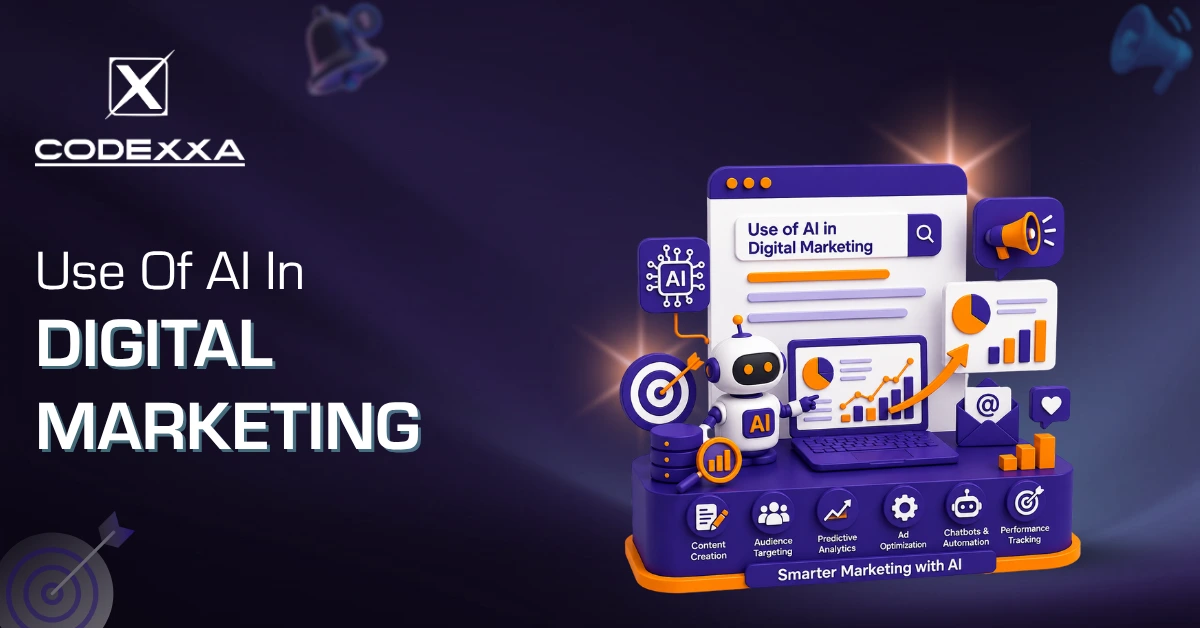
10 Powerful Use of AI in Digital Marketing You Should Know in 2026
Artificial Intelligence is changing how businesses attract, engage, and convert customers online. From creating content to optimizing campaigns, AI is helping marketers make faster and more informed decisions.
As competition increases across digital channels, businesses are using AI to improve efficiency, personalize customer experiences, and achieve better marketing outcomes. Modern AI tools are no longer limited to automation; they are becoming strategic assets for SEO, advertising, analytics, and customer engagement.
In this blog, we’ll explore the key use of AI in digital marketing, how different marketing functions are adopting AI, and why businesses should start integrating AI-driven strategies into their digital marketing plans.
What Is AI in Digital Marketing?
Artificial Intelligence (AI) in digital marketing refers to using machine learning, predictive analytics, and automation to improve marketing decisions and customer experiences.
Instead of relying solely on manual work, AI analyzes large volumes of data, identifies patterns, predicts customer behavior, and recommends actions that improve campaign performance.
Today, AI supports almost every marketing function, including content creation, SEO, paid advertising, email campaigns, customer support, analytics, and audience segmentation.
According to IBM’s Global AI Adoption Index, 42% of enterprise-scale organizations have actively deployed AI in their operations, while 59% have accelerated AI investments during the past two years. This growing adoption highlights AI’s expanding role across modern digital marketing.
Key applications of AI in digital marketing include:
- Generating high-quality marketing content faster.
- Optimizing SEO strategies using search insights.
- Improving paid advertising through smart bidding.
- Personalizing website and email experiences.
- Automating customer support with AI chatbots.
- Predicting customer behavior for better targeting.
- Analyzing marketing performance with real-time insights.
Understanding AI is the first step. The real competitive advantage comes from knowing where to apply it effectively across your digital marketing strategy.
10 Powerful Uses of AI in Digital Marketing
AI has become an integral part of modern digital marketing, helping businesses improve content, advertising, customer engagement, analytics, and decision-making with greater speed and accuracy.
Below are the most valuable use of AI in digital marketing that brands are adopting to improve efficiency, deliver better customer experiences, and achieve stronger marketing results.
1. AI for Content Creation and Optimization
Content marketing demands consistency, quality, and speed across multiple channels. AI helps marketers streamline production without compromising strategic direction or editorial standards.
Today, AI assists with creating blog outlines, drafting articles, writing ad copy, producing email campaigns, and repurposing existing content for different platforms.
Beyond content generation, AI identifies keyword opportunities, evaluates search intent, improves readability, and recommends optimizations that strengthen overall content performance.
According to HubSpot’s State of AI report, 52% of marketers use generative AI for creating text-based marketing content, while 53% rely on it to review and improve content quality before publishing.
AI strengthens content marketing by:
- Creating first drafts more efficiently.
- Identifying keyword opportunities and search intent.
- Improving headings, metadata, and content structure.
- Repurposing content across multiple marketing channels.
- Reviewing content quality before publication.
AI improves productivity, but long-term content performance still depends on human expertise, original insights, and strategic decision-making.
2. AI in Search Engine Optimization (SEO)
Search engine optimization increasingly depends on understanding user intent, content quality, and search behavior. AI helps marketers analyze these signals more efficiently.
Instead of relying on manual research alone, AI identifies keyword opportunities, clusters related topics, uncovers content gaps, and recommends optimizations based on search intent.
AI also supports technical SEO by detecting crawl issues, improving internal linking, generating metadata, and prioritizing pages requiring optimization for better visibility.
According to SEMrush, around 85% of marketers have already adjusted their search strategies because of AI, reflecting its growing influence on modern SEO.
AI supports SEO by helping marketers:
- Discover high-value keyword opportunities.
- Group keywords into topical clusters.
- Identify content gaps against competitors.
- Generate optimized titles and meta descriptions.
- Improve internal linking and content structure.
- Analyze search intent before creating content.
- Prioritize technical SEO improvements efficiently.
AI makes SEO faster and more data-driven, while sustainable rankings still depend on expertise, original content, and consistent optimization.
3. AI-Powered Paid Advertising
Paid advertising requires constant optimization of targeting, bidding, creatives, and audience signals. AI helps marketers automate these decisions and improve campaign performance with real-time data analysis.
Platforms like Google Ads and Meta Ads now use AI to identify high-value audiences, adjust bids, generate creative variations, and allocate budgets based on campaign goals.
AI-powered advertising enables marketers to move beyond manual campaign management by analyzing user behavior, predicting conversion opportunities, and improving ad delivery across multiple channels.
Google has expanded AI capabilities across its advertising ecosystem, including Performance Max and AI-powered Search campaigns, helping advertisers improve reach, relevance, and conversion performance.
AI improves paid advertising through:
- Automated bidding based on conversion goals.
- Smarter audience targeting and segmentation.
- Faster testing of ad variations.
- Budget allocation based on performance signals.
- Predictive insights for campaign optimization.
- Improved personalization across customer touchpoints.
AI makes paid campaigns more efficient, but successful advertising still requires a strong strategy, accurate data, and continuous human evaluation.
4. AI for Personalization at Scale
Customers now expect brands to understand their preferences, interests, and behavior across every interaction. AI helps businesses deliver personalized experiences without manually managing individual customer journeys.
AI analyzes customer data, browsing patterns, purchase history, and engagement signals to create relevant experiences across websites, emails, advertisements, and communication channels.
Businesses can use AI personalization in several ways:
- Personalized Product Recommendations:
AI analyzes previous interactions and purchase behavior to suggest products or services that match individual customer interests. - Dynamic Website Experiences:
AI can adjust website content, offers, and recommendations based on visitor behavior, location, and preferences. - Targeted Email Campaigns:
AI helps create personalized email content, product suggestions, and send-time optimization based on customer engagement patterns. - Customized Advertising:
AI improves ad targeting by identifying audience segments and delivering relevant messages based on user intent and behavior. - Predictive Customer Insights:
AI predicts future customer actions, helping businesses identify purchase opportunities and create proactive marketing campaigns.
According to McKinsey, 71% of consumers expect companies to deliver personalized interactions, while 76% feel frustrated when brands fail to provide them.
AI allows businesses to scale personalization effectively, but successful implementation still requires accurate data, clear customer understanding, and responsible use of information.
5. AI in Email Marketing Automation
Email marketing is no longer limited to sending the same message to an entire subscriber list. AI helps businesses create smarter workflows that respond to customer behavior, preferences, and engagement patterns.
By analyzing previous interactions, AI can determine what content users are likely to engage with, when they are most likely to open emails, and which messages can drive better conversions.
Traditional Email Marketing vs AI-Powered Email Automation:
| Traditional Approach | AI-Powered Approach |
| Manual audience segmentation. | Automated segmentation based on customer behavior and interests. |
| Fixed email schedules. | Predictive send times based on user engagement patterns. |
| Generic email content. | Personalized recommendations and dynamic messaging. |
| Manual campaign analysis. | Automated insights and performance optimization. |
Businesses can use AI in email marketing automation for:
- Smart Audience Segmentation: Identifying customer groups based on behavior, preferences, purchase history, and engagement levels.
- Automated Customer Journeys: Creating workflows that automatically send relevant messages based on actions like sign-ups, purchases, or abandoned carts.
- Email Content Optimization: Improving subject lines, messaging, and recommendations to increase engagement.
- Predictive Campaign Decisions: Using customer data to determine the right message, timing, and frequency for each subscriber.
AI helps email marketing become more personalized and efficient, allowing businesses to build stronger customer relationships while reducing manual campaign management.
6. AI Chatbots and Conversational Marketing
Customer expectations for instant responses have changed how businesses communicate online. AI chatbots help brands engage visitors, answer queries, and guide customers throughout their buying journey.
Unlike traditional chat systems, AI-powered chatbots understand user intent, provide relevant responses, and handle conversations across websites, social platforms, and messaging channels.
AI chatbots support marketing conversations across three key stages:
1. Before Purchase: Capturing and Qualifying Leads
AI chatbots engage website visitors instantly, collect important customer details, answer common questions, and identify high-intent prospects for sales teams.
2. During Purchase: Guiding Customer Decisions
Chatbots help users compare products, recommend suitable options, provide additional information, and reduce friction during the buying process.
3. After Purchase: Improving Customer Support
AI chatbots assist with order updates, FAQs, feedback collection, and customer queries, helping brands maintain stronger relationships after conversion.
According to Gartner, 85% of customer service leaders planned to explore or pilot customer-facing conversational AI solutions in 2025, showing the growing adoption of AI-powered conversations.
AI chatbots work best when combined with human support, allowing businesses to automate routine interactions while maintaining personalized customer experiences.
7. AI for Social Media Marketing
Managing social media requires constant content creation, audience interaction, trend monitoring, and performance analysis. AI helps marketers handle these activities more efficiently while making data-driven decisions.
From generating post ideas to analyzing audience behavior, AI supports multiple areas of social media management and helps brands maintain consistent communication across platforms.
How AI improves different social media marketing tasks:
| Social Media Task | How AI Helps |
| Content Planning | Identifies trending topics, suggests content ideas, and helps create posting strategies. |
| Content Creation | Generates captions, designs, and creative variations based on brand requirements. |
| Audience Analysis | Studies user behavior, interests, and engagement patterns to understand audiences better. |
| Community Management | Helps monitor comments, respond to common queries, and track brand conversations. |
| Performance Analysis | Evaluates campaign results and provides insights for improving future content. |
AI also helps brands identify emerging trends faster by analyzing large amounts of social media data and user interactions.
By combining AI capabilities with human creativity, businesses can create more relevant content, strengthen audience relationships, and improve social media performance.
8. AI in Marketing Analytics and Reporting
Marketing teams generate large amounts of data from websites, campaigns, social platforms, and customer interactions. AI helps convert this complex information into clear insights and actionable decisions.
Instead of manually analyzing multiple reports, AI identifies patterns, detects performance changes, and highlights opportunities that marketers may overlook.
How AI transforms marketing analytics:
1. Data Collection and Organization
AI collects and processes information from different marketing channels, creating a unified view of campaign performance and customer behavior.
2. Pattern Detection and Performance Analysis
AI analyzes trends, identifies successful strategies, detects issues, and explains why certain campaigns perform better than others.
3. Predictive Insights and Decision Support
AI uses historical data to forecast future outcomes, helping marketers optimize budgets, improve targeting, and plan upcoming campaigns.
AI-driven analytics helps businesses:
- Understand customer behavior more accurately.
- Identify high-performing marketing channels.
- Predict campaign outcomes before investing more resources.
- Create faster and more detailed performance reports.
- Make decisions based on real-time data insights.
AI does not replace marketing judgment; it strengthens decision-making by helping teams understand what the data is showing and where improvements are needed.
9. AI for Customer Journey Mapping
Customer journey mapping helps brands understand how people move from first interaction to final conversion. AI makes that journey clearer by connecting signals across channels and revealing behavior patterns.
Instead of treating each touchpoint separately, AI links website visits, ad clicks, email opens, product views, and support interactions into a single customer view.
AI can help businesses map the journey through three layers:
1. Touchpoint Visibility
AI tracks where customers enter, engage, and drop off across campaigns, websites, and social platforms.
2. Behavior Interpretation
AI identifies repeated actions, hesitation points, and purchase signals that explain how customers move through the funnel.
3. Journey Improvement
AI highlights friction areas, recommends next steps, and helps marketers design smoother paths toward conversion.
Customer journey mapping works best when AI and human analysis are used together, and where AI shows the pattern, marketers decide the response.
10. AI in Voice Search and Visual Search Optimization
Search behavior is moving beyond traditional text queries. AI-powered voice and visual search technologies are helping users find information through conversations, images, and real-world objects.
For marketers, this shift requires optimizing content and digital assets according to how people naturally search and discover products.
Voice Search Optimization
AI improves voice search by understanding conversational language, user intent, and context behind spoken queries.
Businesses can optimize for voice search by:
- Creating content that answers specific customer questions.
- Targeting conversational and long-tail keywords.
- Optimizing local SEO elements for location-based searches.
- Using structured data to help search engines understand content.
Visual Search Optimization
AI-powered visual search allows users to search through images instead of written queries. Platforms use image recognition technology to identify products, objects, and visual patterns.
Businesses can improve visual search visibility by:
- Adding descriptive image names and alt text.
- Using high-quality product images.
- Optimizing visual content with relevant metadata.
- Creating image-rich pages for better discovery.
As AI continues improving search experiences, businesses that optimize for both voice and visual discovery can create more opportunities to reach customers across emerging search channels.
Also Check: 12 Powerful AI Tools for Digital Marketing in 2026
Conclusion
AI is reshaping digital marketing by helping businesses create better content, understand customers, optimize campaigns, and make smarter decisions with data.
From SEO and paid advertising to personalization and automation, the use of AI in digital marketing is becoming essential for brands that want to improve efficiency and stay competitive.
However, successful AI adoption requires the right strategy, tools, and expertise. Businesses that combine AI capabilities with human creativity and marketing knowledge can achieve stronger long-term results.
If you want to build an AI-driven digital marketing strategy that improves visibility, engagement, and conversions, connect with Codexxa’s digital marketing experts today.
Add Comment