

17 Best AI Tools for eCommerce that Automate Almost Everything
Why are some eCommerce stores growing faster while others struggle to keep up?
Because AI is changing how online businesses sell, support, and scale every day.
Manual tasks slow teams down. Generic campaigns miss intent. Slow decisions cost revenue.
AI tools help eCommerce brands automate repetitive work, personalize shopping, and improve conversions without adding unnecessary operational load.
They also make product discovery sharper, pricing smarter, and customer interactions faster across the entire buying journey.
In this blog, you’ll explore best AI tools for ecommerce that works with your business, automating repetitive tasks that actually drives revenue.
Why AI Tools Are Essential for Modern eCommerce Growth
AI is no longer optional in eCommerce. It has become a core driver of growth, efficiency, and competitive advantage across online businesses.
Today, customers expect personalized experiences, faster responses, and relevant product recommendations at every stage of their buying journey. According to McKinsey, companies that excel at personalization generate 40% more revenue from those activities than average players.
AI tools enable this by analyzing customer behavior, predicting intent, and delivering tailored experiences that directly improve conversions and retention.
Instead of relying on manual processes, businesses now automate marketing, pricing, and customer interactions using intelligent, data-driven systems.
Key areas where AI creates a measurable impact for eCommerce businesses:
| Area | How AI Drives Growth |
| Customer Experience | Personalized recommendations increase engagement and session duration |
| Marketing | Predictive targeting improves ROI and reduces acquisition costs |
| Operations | Automation speeds execution and reduces human errors |
| Pricing | Real-time adjustments maximize competitiveness and margins |
| Retention | Behavioral insights improve repeat purchases and lifetime value |
AI also accelerates decision-making by processing large datasets instantly, helping brands respond faster to trends and customer behavior shifts.
Businesses adopting AI early gain a clear advantage in scalability, efficiency, and customer satisfaction, making it essential for long-term eCommerce success.
17 Best AI Tools for eCommerce in 2026
Here are the best AI tools for eCommerce that help automate workflows, improve customer experience, and scale your online store efficiently.
Let’s start with core AI ecommerce tools focused on personalization, product discovery, pricing, and revenue-driven growth.
1. Shopify Magic

Shopify Magic is an advanced AI system built into Shopify, designed to automate content, workflows, and decision-making across your eCommerce store. It goes beyond basic automation by introducing Sidekick, an AI assistant that understands your store data and provides actionable insights instantly.
From product content to customer conversations, Shopify Magic helps brands execute faster while maintaining consistency, personalization, and performance across operations.
Its deep integration allows real-time analysis, enabling smarter decisions, better customer experiences, and faster scaling without increasing operational complexity.
Key Features and Benefits:
- Generates high-converting product descriptions using SEO-focused keywords.
- Creates AI-optimized email campaigns with subject lines, content, and timing.
- Transforms product images with AI background editing and enhancements.
- Automates customer chat responses to improve conversions and support speed.
- Provides real-time insights and recommendations through Sidekick AI assistant.
- Simplifies complex workflows like setup, metafields, and store management.
Pricing:
Shopify Magic is included within Shopify plans at no additional cost, but requires an active Shopify subscription to access all features.
2. Klaviyo AI
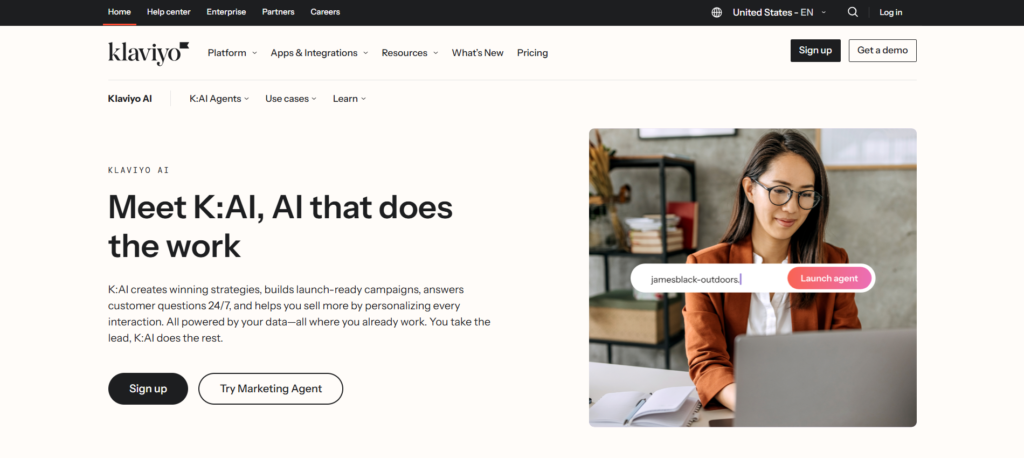
Klaviyo AI is an advanced B2C CRM platform designed specifically for eCommerce brands to automate marketing, customer engagement, and revenue growth. It unifies customer data, campaigns, and communication channels into one system, allowing businesses to deliver highly personalized experiences in real time.
With AI agents like Marketing Agent and Customer Agent, Klaviyo can create campaigns, automate flows, and even resolve customer queries without manual effort.
This makes it powerful for scaling brands, as it continuously learns from customer behavior and optimizes every interaction across email, SMS, and more.
Unlike traditional tools, Klaviyo focuses on revenue-driven marketing by combining analytics, automation, and personalization into a single growth engine.
Key Features and Benefits:
- Creates complete email and SMS campaigns using AI with minimal input.
- Unifies customer data for real-time personalization across all channels.
- Automates customer support while recommending products to increase sales.
- Provides predictive analytics to improve targeting and campaign performance.
- Integrates with 350+ platforms, including Shopify and WooCommerce.
- Tracks behavior and triggers automated flows based on real-time actions.
Pricing:
Klaviyo offers a free plan with limited features, while paid plans scale based on contacts, usage, and advanced automation requirements.
3. Rebuy Personalization Engine
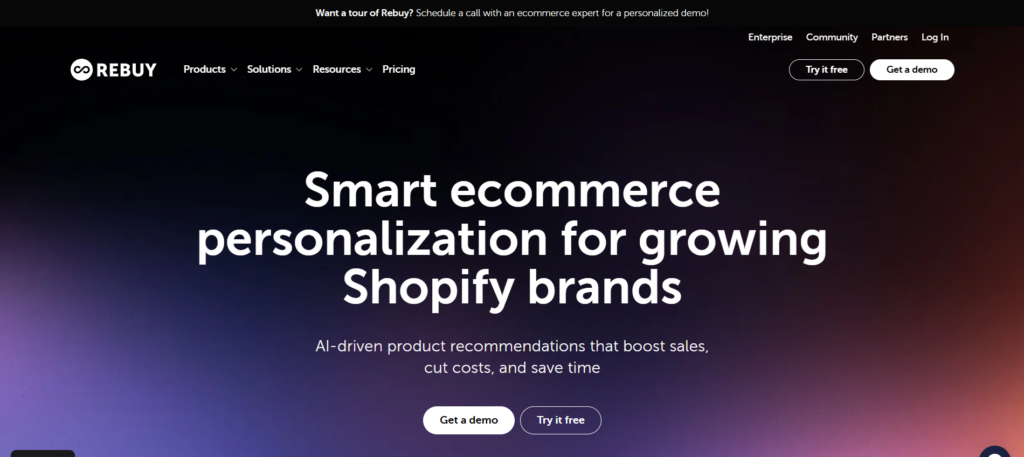
Rebuy is a powerful AI-driven personalization platform built specifically for Shopify stores, focusing on increasing conversions, AOV, and customer lifetime value. It uses machine learning to analyze shopper behavior in real time, delivering highly relevant product recommendations across every stage of the buying journey.
From homepage to checkout and even post-purchase, Rebuy ensures customers see the right products at the right time, improving overall shopping experience.
Over 50,000+ Shopify brands use Rebuy, collectively generating over $1 billion in additional revenue through AI-powered personalization strategies.
Instead of static product displays, Rebuy dynamically adapts offers, bundles, and upsells based on user intent, maximizing revenue opportunities automatically.
Key Features and Benefits:
- Delivers real-time product recommendations across homepage, cart, and checkout.
- Increases AOV using AI-powered upsells, bundles, and cross-sell strategies.
- Offers Smart Cart with built-in conversion-focused features and integrations.
- Uses an advanced rules engine for personalized shopping experiences.
- Supports dynamic bundles to improve product discovery and reduce friction.
- Integrates seamlessly with Shopify and leading eCommerce tools.
Pricing:
Rebuy offers a free trial, while pricing is customized based on store size, usage, and feature requirements.
4. Nosto
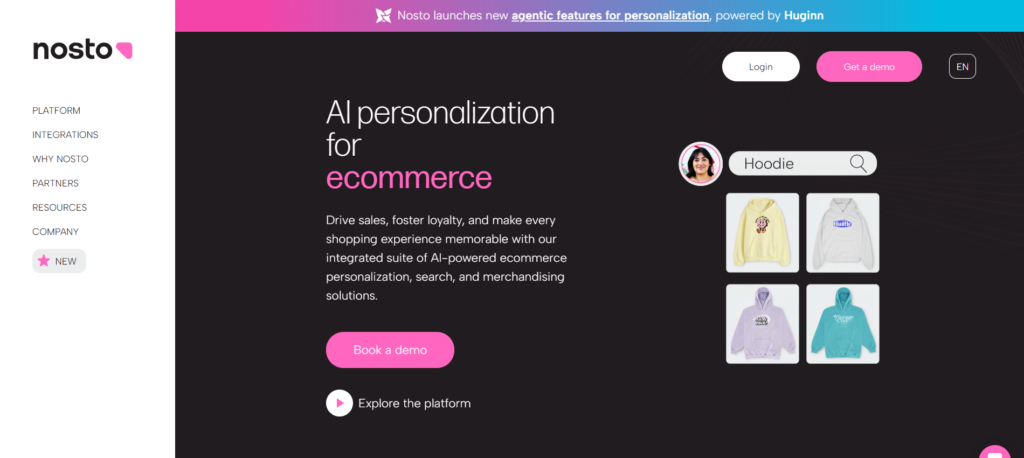
Nosto is an AI-powered ecommerce personalization platform that turns real-time customer data into revenue through highly targeted shopping experiences. It helps brands to deliver predictive product recommendations, personalized search results, and dynamic merchandising to each shopper’s behavior instantly.
With its AI agent “Huginn,” Nosto goes beyond automation by identifying revenue opportunities, optimizing campaigns, and improving customer journeys continuously without manual effort.
Brands using Nosto have reported up to 43% increase in conversions and 58% growth in average order value through advanced personalization strategies.
Key Features and Benefits:
- Delivers predictive product recommendations based on real-time behavioral data.
- Personalizes on-site search results to improve product discovery and conversions.
- Optimizes merchandising with dynamic product placements and A/B testing.
- Uses AI agents to identify revenue opportunities and automate optimization.
- Enhances post-purchase upsells with personalized product offers.
- Integrates seamlessly with major ecommerce platforms and tools.
Pricing:
Nosto offers custom pricing based on business size, traffic, and feature usage, with demo access available for evaluation.
5. Dynamic Yield
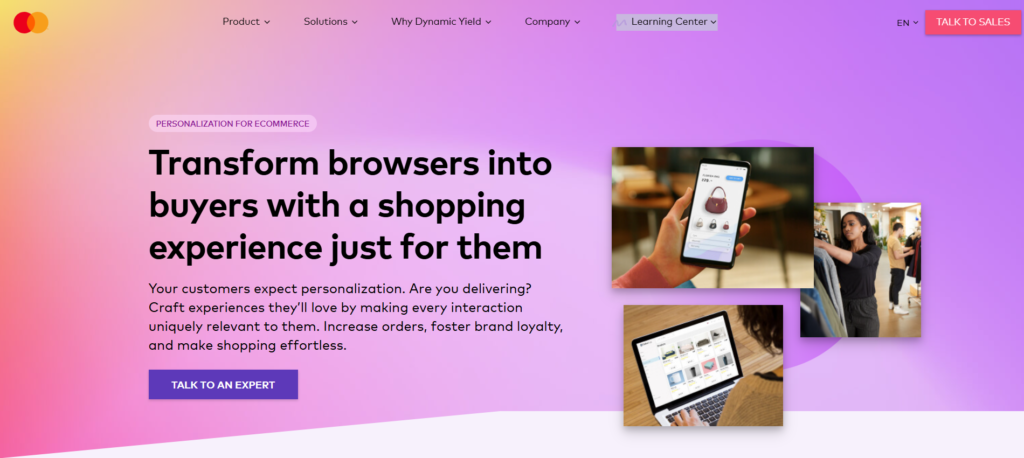
Dynamic Yield helps brands create personalized ecommerce experiences that respond to shopper behavior, context, and intent in real time.
Its Experience OS connects personalization, recommendations, audience targeting, and A/B testing, so teams can improve revenue without adding more tools.
For growing stores, that means fewer guesses, faster experimentation, and sharper product offers across every digital touchpoint.
It is especially useful for brands that want structured personalization at scale, with strong control over what customers see and when.
Key Features and Benefits:
- Matches content, products, and offers to individual customer preferences.
- Uses AI-powered recommendations to increase relevance and basket size.
- Supports audience segmentation, targeting, and journey orchestration.
- Includes A/B testing and optimization for measurable conversion gains.
- Integrates with major commerce and marketing tools already in your stack.
- Helps teams launch personalization faster with guided onboarding and support.
Pricing:
Dynamic Yield offers customized pricing based on business needs, scale, and implementation requirements. A demo is available before purchase.
6. Algolia
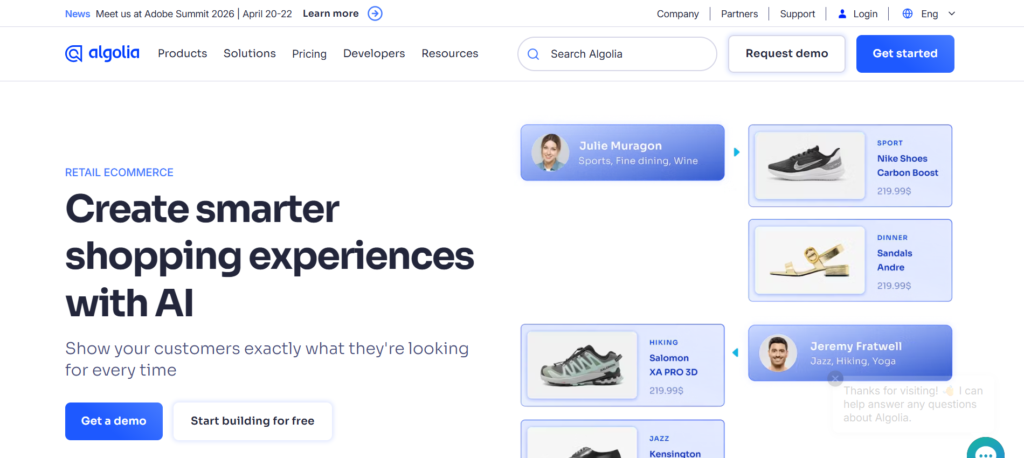
Search is one of the highest conversion touchpoints in any eCommerce store, and most default search experiences fail to capture real buyer intent.
Algolia fixes this by using AI to understand what users actually mean, not just what they type, delivering faster and more relevant results. It processes queries in milliseconds while dynamically ranking products based on behavior, popularity, and real-time interactions.
More than 18,000 companies across 150+ countries rely on Algolia to power search, discovery, and personalized shopping journeys at scale.
What makes it powerful for eCommerce growth:
- Instant search results improve user experience and reduce bounce rates.
- AI understands intent instead of relying only on keyword matching.
- Dynamic ranking pushes high-converting products automatically.
- Advanced filters and facets improve product discovery.
- Real-time analytics helps optimize search performance.
- Easy integration with Shopify, Magento, and custom stacks.
Pricing:
Algolia offers a free plan for basic usage, while advanced features scale based on search volume and infrastructure needs.
7. Athos Commerce
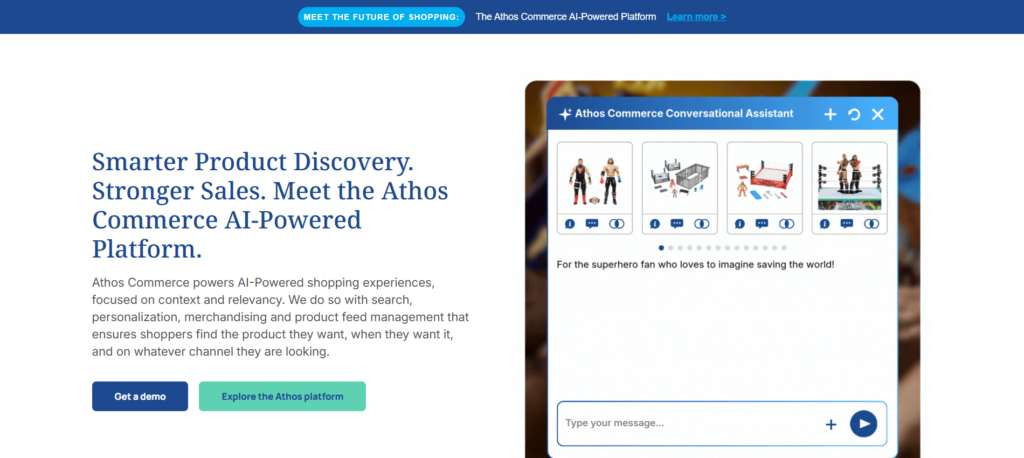
Athos Commerce is built around one core idea where every shopper should see products that feel relevant the moment they land on your store. It combines AI-powered search, merchandising, and personalization into a single system that continuously adapts based on shopper behavior and context.
Instead of relying on fixed product grids, it reshapes discovery in real time, ensuring high-intent products get visibility when it matters most.
This approach improves how users browse, compare, and decide, making the overall shopping journey faster, smoother, and more conversion-focused.
Key Features and Benefits:
- AI-driven search delivers highly relevant results instantly.
- Real-time personalization adapts to each shopper’s behavior.
- Dynamic merchandising highlights high-performing products automatically.
- Improves product discovery across categories and pages.
- Supports consistent experience across multiple sales channels.
- Optimizes product feeds for better visibility and engagement.
Pricing:
Athos Commerce offers custom pricing depending on business scale and requirements, with demo access available for evaluation.
8. Prisync
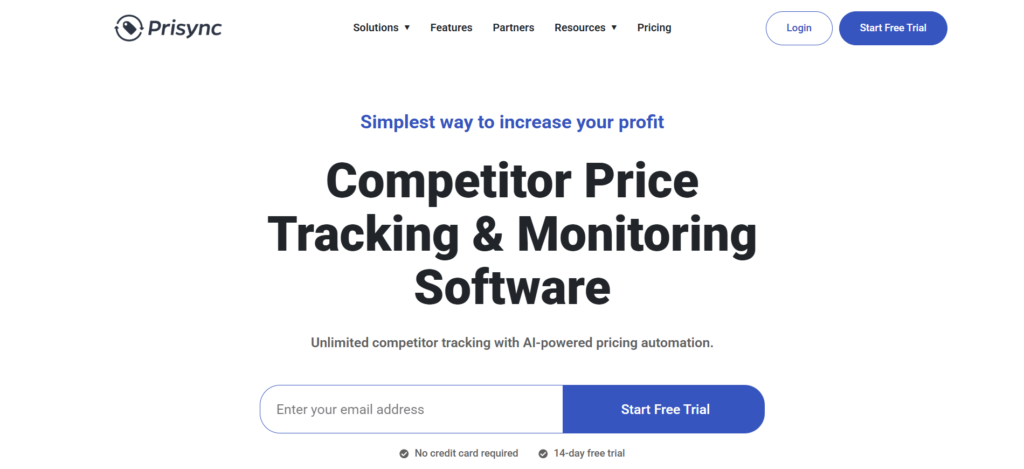
Pricing mistakes silently reduce our ecommerce profits when competitors constantly adjust product prices across multiple marketplaces and sales channels.
Prisync is an AI-powered ecommerce tool designed to automate competitor price tracking and dynamic pricing for better profitability control. It continuously monitors competitor pricing, stock availability, and market trends across platforms like Shopify, Amazon, and Google Shopping.
Instead of manual tracking, businesses get real-time insights that help them react faster and maintain competitive pricing strategies effectively.
This makes Prisync one of the most practical ecommerce automation tools focused directly on improving margins and revenue performance.
Key Features & Benefits:
- AI-powered competitor price tracking across multiple sales channels.
- Dynamic pricing automation based on real-time competitor data.
- Centralized dashboard to monitor pricing, stock, and market insights.
- Marketplace integrations including Shopify, Amazon, and Google Shopping.
- Bulk price updates to save time and reduce manual effort.
- Advanced pricing intelligence for smarter decision-making.
Pricing:
- Prisync offers a 14-day free trial without requiring a credit card.
- Paid plans start from $99 per month and scale based on product volume and features.
9. Octane AI
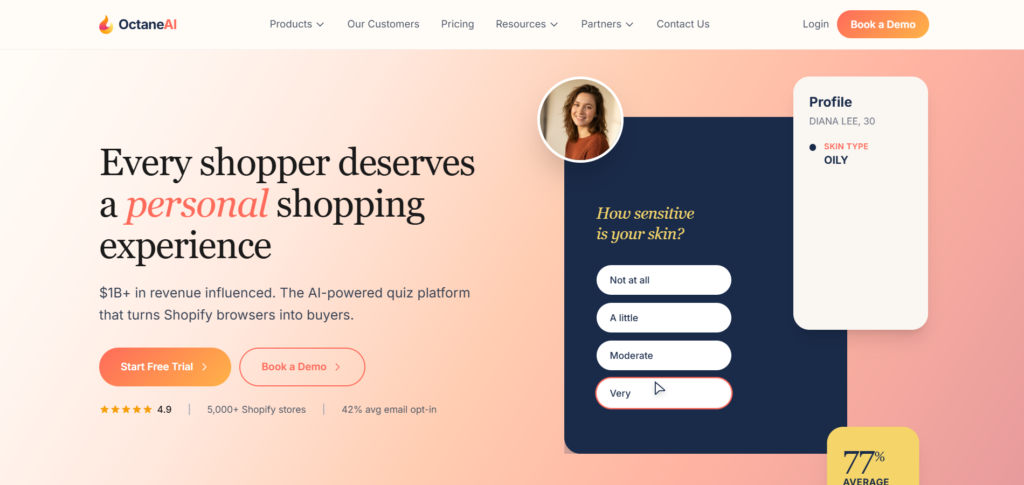
Octane AI turns product discovery into a guided experience, helping Shopify shoppers find the right product faster.
Instead of sending traffic to static collections, it uses quizzes to capture intent, preferences, and purchase context directly. That matters because zero-party data creates sharper recommendations, better segmentation, and stronger email and SMS follow-up flows.
For ecommerce brands, this means fewer abandoned visits and more qualified buyers moving through the funnel with confidence.
Key Features and Benefits:
- AI-powered quizzes that recommend products based on shopper answers.
- Zero-party data collection for stronger personalization and segmentation.
- Klaviyo and Shopify sync for real-time automated marketing flows.
- Industry-specific quiz templates for beauty, skincare, fashion, supplements, and more.
- Higher email opt-in rates through interactive lead capture.
- Better conversion rates, AOV, and product-fit accuracy.
Pricing:
Octane AI Basic starts at $50 per month with 400 credits included. Higher tiers include more quizzes, advanced analytics, branding control, and white-glove support.
Now, let’s move into marketing and content-focused AI ecommerce tools that help you create, personalize, and scale campaigns, driving real conversions.
10. ChatGPT

ChatGPT is one of the most widely used AI ecommerce tools for creating high-converting content, automating workflows, and improving customer engagement.
Instead of hiring multiple specialists, ecommerce brands use ChatGPT to generate product descriptions, ad copies, emails, and SEO content at scale.
It helps teams move faster by turning simple prompts into structured marketing assets, reducing content production time significantly across campaigns.
Beyond content, ChatGPT supports customer service automation, conversational selling, and personalized responses that improve user experience and retention.
It also plays a growing role in AI-driven shopping experiences, where users discover products directly through conversational queries instead of traditional search.
Key Features and Benefits:
- AI-powered content generation for product pages, ads, blogs, and emails.
- Conversational AI for customer support and real-time query handling.
- SEO assistance including keyword ideas, outlines, and optimization.
- Personalized messaging for email, SMS, and chatbot interactions.
- Rapid content production that improves marketing efficiency and scalability.
- Versatile use cases across content, support, and conversion optimization.
Pricing:
- ChatGPT offers a free plan with basic access.
- Paid plans like Plus and Team unlock advanced models, faster responses, and enhanced capabilities.
11. Jasper AI
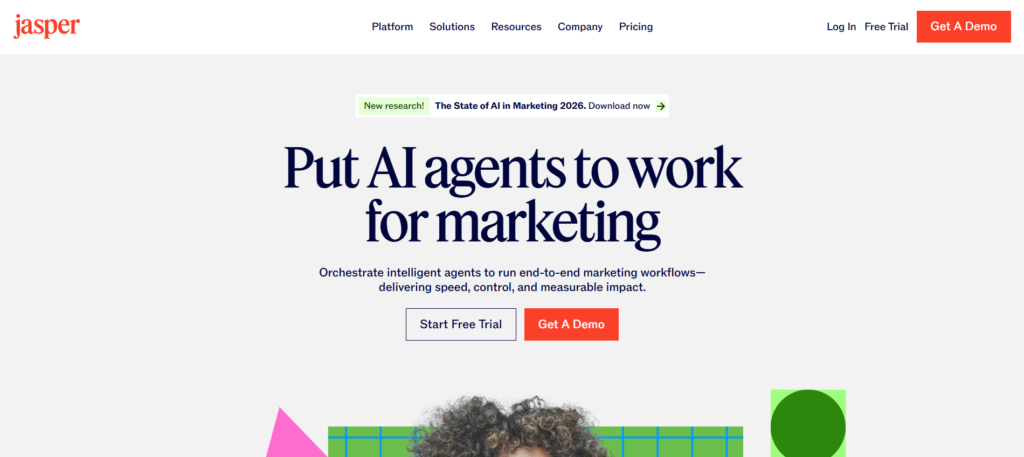
Jasper AI is built for ecommerce teams that need to scale high-quality marketing content while maintaining brand consistency across every channel.
Unlike basic writing tools, it uses AI agents and structured workflows to turn campaign ideas into fully executed marketing assets faster.
It connects strategy, brand voice, and execution, allowing ecommerce brands to produce SEO content, ads, emails, and landing pages efficiently.
Jasper also helps teams maintain consistency by using a centralized brand voice system, ensuring every output aligns with messaging guidelines.
This makes it one of the most reliable AI ecommerce tools for scaling content operations without losing control over quality.
Key Features and Benefits:
- AI agents to automate end-to-end marketing workflows.
- Content pipelines that turn ideas into publish-ready campaigns.
- Brand voice control to maintain consistency across all content.
- SEO, ads, blogs, and email content generation at scale.
- Campaign creation tools for multi-channel marketing execution.
- Enterprise-grade collaboration and workflow management.
Pricing:
Jasper AI offers custom pricing based on team size and usage. Free trial is available.
12. Copy AI
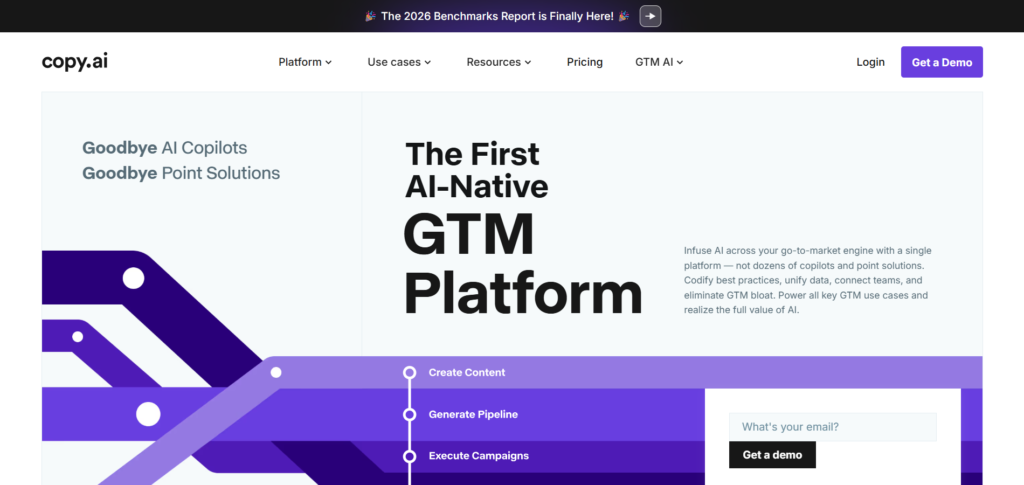
Copy AI fits ecommerce brands that need faster marketing execution, consistent messaging, and reduced dependency on scattered AI tools. It operates as a unified GTM platform, combining workflows, AI agents, and data layers to automate content, outreach, and campaign processes.
For ecommerce teams, this translates into faster product descriptions, SEO blogs, ad creatives, email flows, and localized content across markets.
Its strongest advantage is structured execution. Instead of random prompts, Copy AI builds repeatable workflows that maintain quality and brand consistency.
Key Features and Benefits:
- Creates structured workflows for product pages, blogs, ads, and campaigns.
- Maintains consistent messaging using Brand Voice across all outputs.
- Automates content, outreach, and lead processing with AI agents.
- Supports real-time translation and localization for global stores.
- Unifies data, teams, and GTM execution in one platform.
- Reduces manual workload while increasing content production speed.
Pricing:
- Copy AI offers entry-level plans starting around $29/month.
- Advanced plans scale to Growth and Enterprise tiers based on usage, workflows, and team requirements.
13. Synthesia
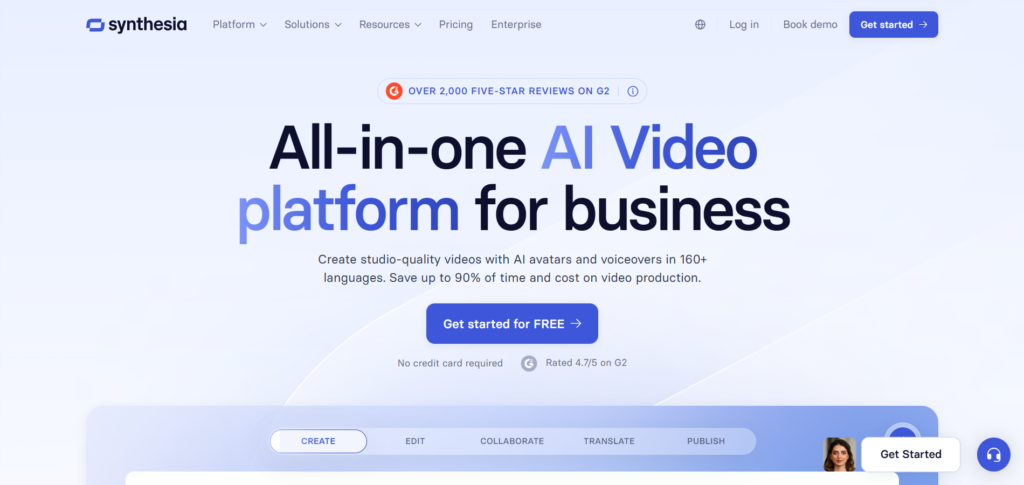
Video content is expensive, slow, and difficult to scale when ecommerce teams need constant product, ad, and training assets.
Synthesia removes that bottleneck by turning scripts, documents, and ideas into polished AI videos with avatars and voiceovers in 160+ languages. That makes it useful for ecommerce brands that need product explainers, ad creatives, onboarding videos, and localized content without a full production team.
It also keeps every video on-brand with built-in editing, collaboration, and version control, which matters when campaigns move across markets quickly. :contentReference[oaicite:1]{index=1}
Key Features and Benefits:
- Create studio-quality videos with AI avatars and voiceovers.
- Translate and publish videos in 160+ languages.
- Turn scripts, links, and documents into videos instantly.
- Collaborate, edit, and review content in one platform.
- Keep videos consistent with brand kits and version control.
- Use analytics to track views, drop-offs, and completion rates.
Pricing:
- Synthesia has a free plan with up to 10 minutes of video per month, 9 stock avatars, and AI voices in 160+ languages.
- Paid plans start at $29/month.
14. Pictory

Pictory is another AI ecommerce tool that fulfills video content quickly, without cameras, editing software, or production delays.
It turns text, scripts, blogs, URLs, images, and existing videos into polished video assets with captions, avatars, and voiceovers.
That makes it practical for product explainers, social ads, tutorials, and repurposed blog content that supports ecommerce marketing at scale.
For brands that publish often, Pictory removes the slowest part of video production and keeps output ready for multiple channels.
What makes it useful for ecommerce:
- Turns blogs and product pages into videos automatically.
- Creates captions, voiceovers, and AI visuals in minutes.
- Supports different formats for social, ads, and presentations.
- Helps teams repurpose existing content into video quickly.
- Reduces production friction for marketing and training content.
- Works well when you need volume, speed, and consistency.
Pricing:
Pictory offers a free trial while paid plans starts at $25 per month.
Now, let’s see how AI tools streamline ecommerce operations and customer experience by automating support, reducing response times, and improving retention.
15. Tidio AI
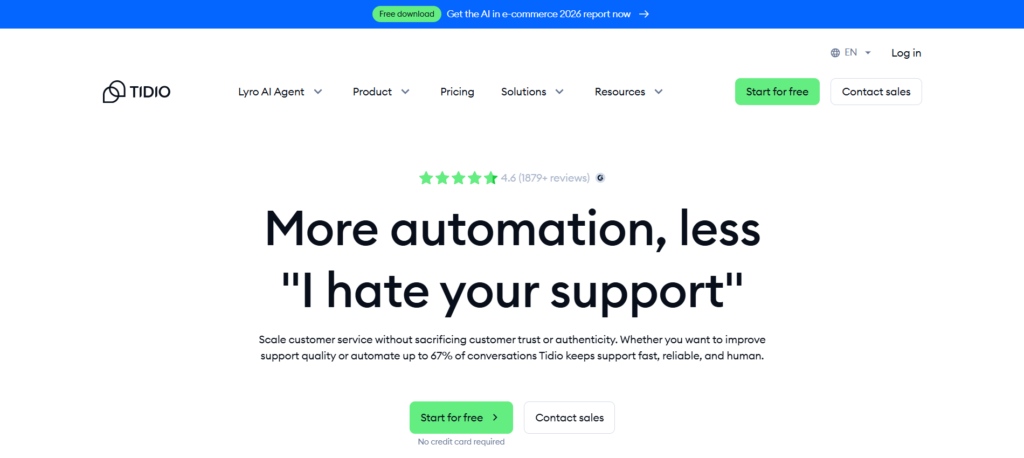
Tidio AI is built for ecommerce stores that need faster support without sacrificing trust, brand voice, or conversion opportunities.
Its Lyro AI Agent handles repetitive questions using verified support content, so answers stay useful, human-like, and reliable.
This is important for ecommerce because it usually covers shipping, orders, product availability, and pre-purchase hesitation at the exact moment sales are at risk.
With live chat, help desk, and Flows in one system, Tidio helps teams move faster while keeping customer service personal.
Key Features and Benefits:
- Lyro AI Agent can automate up to 67% of customer problems.
- Lyro learns from verified support content, which improves response quality and consistency.
- Flows and Lyro Smart Actions help automate leads, sales, and repetitive support tasks.
- Live chat and help desk keep human handoff smooth when issues need manual attention.
- Tidio integrates with Shopify, Mailchimp, HubSpot, Zendesk, Zapier, and 120+ tools.
- Tidio is trusted by 300K+ businesses and is positioned as a customer service suite built for sales and support.
Pricing:
Tidio starts free, but Lyro AI Agent starts at $32.50 per month from 50 conversations, with a 7-day free trial.
16. Vue AI

Vue AI is one of the more enterprise-focused AI tools for ecommerce, especially when brands need data cleanup, automation, and merchandising at scale.
It helps teams manage product tagging, content moderation, on-model imagery, and personalization without relying on multiple disconnected ecommerce automation tools.
What makes it useful for retailers is its ability to deal with large catalogs, inconsistent data, and slow manual workflows that damage product discovery.
For fashion and retail brands, Vue AI also improves visual consistency, inventory handling, and customer journeys across commerce operations.
Why Vue AI stands out:
- Automates product tagging for cleaner catalogs.
- Creates on-model imagery for fashion and retail brands.
- Supports content moderation and inventory-related workflows.
- Improves personalized ecommerce and marketing journeys.
- Helps teams move faster with fewer manual steps.
- Built for large-scale enterprise automation use cases.
Pricing:
Vue AI offers a demo-led enterprise pricing model.
17. Claimlane
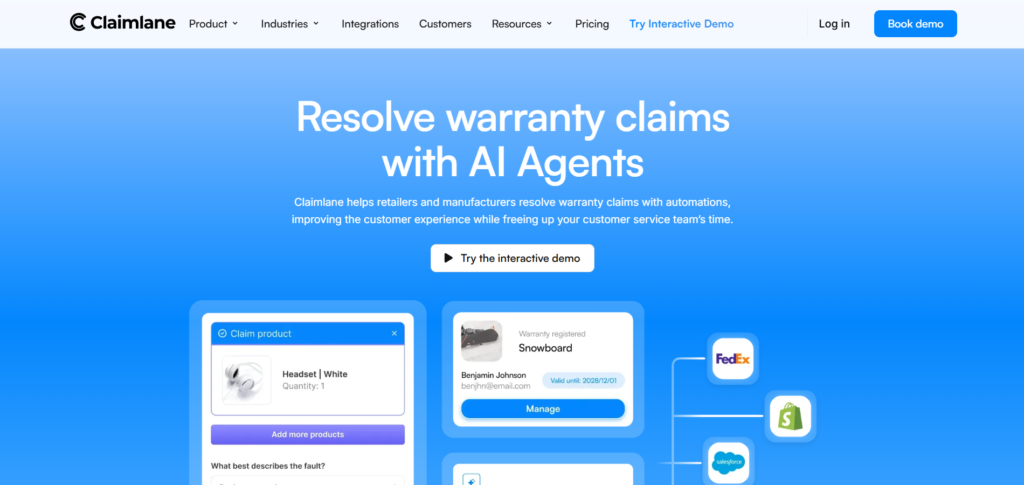
Claimlane is built for ecommerce brands that lose too much time handling warranty claims, repairs, and complex post-purchase issues manually. Instead of forcing support teams to manage everything through email or help desks, Claimlane brings self-service, AI agents, and automated workflows into one platform.
This AI ecommerce tool is useful for brands selling furniture, electronics, outdoor gear, and other products where returns and claims are rarely simple.
Its AI Agent uses supplier data, customer data, and product data to resolve warranty claims, replacements, and repairs faster.
What Claimlane helps with:
- Self-service claim intake with photos, videos, serial numbers, and required evidence.
- Automated routing for refunds, repairs, replacements, and supplier claims.
- Centralized after-sales management across tickets, workflows, statuses, and communication.
- Deep integrations with ecommerce, ERP, and shipping systems.
- Fast setup for simpler stores, with more complex implementations taking longer.
Pricing:
Claimlane pricing starts at $499 per month for the Core plan, and enterprise pricing is available on request.
How to Choose the Right AI Tools for Your eCommerce Store?
Choosing the right AI tools for ecommerce depends on your growth stage, biggest bottlenecks, and how each tool impacts revenue or operations.
Here’s a quick breakdown of where each ecommerce AI tool delivers the most value across your store operations:
| Tool | Best Use Case |
| Shopify Magic | Store automation, product descriptions, and emails |
| Klaviyo AI | Email marketing, retention, customer segmentation |
| Rebuy Personalization Engine | Upselling, cross-selling, increasing AOV |
| Nosto | Personalization, merchandising, engagement |
| Dynamic Yield | Advanced personalization, A/B testing, CRO |
| Algolia | AI search, product discovery, UX optimization |
| Athos Commerce | Smart search, merchandising, and personalization |
| Prisync | Dynamic pricing, competitor price tracking |
| Octane AI | Quizzes, zero-party data collection, funnels |
| ChatGPT | Content creation, support automation, and ideation |
| Jasper AI | Marketing copy, ads, and landing page optimization |
| Copy AI | Campaign content, product pages, GTM workflows |
| Synthesia | AI video creation, product explainers, ads |
| Pictory | Content repurposing, blog-to-video, social content |
| Tidio AI | Customer support, chat automation, lead conversion |
| Vue AI | Catalog management, tagging, and visual merchandising |
| Claimlane | Warranty claims, returns, aftersales automation |
Start by identifying your biggest constraint, whether it is pricing, content, support, or operations, then choose tools that directly solve that problem.
Avoid stacking multiple ecommerce automation tools without understanding where they add value or increase productivity, as disconnected systems reduce efficiency and create unnecessary operational complexity.
Also Check: 12 Powerful AI Tools for Digital Marketing in 2026
Final Thoughts
The best AI tools for ecommerce are not the ones with the most features; they are the ones solving real bottlenecks.
From product discovery and pricing to content, support, and after-sales, the right tools create measurable impact across the entire store journey.
Select carefully, implement gradually, and prioritize revenue-driven use cases first. That is how AI tools for ecommerce become real growth assets.
Add Comment