

Facebook Ads vs Google Ads: Which Is Better for Business ROI?
Choosing the right paid advertising platform is a common challenge for businesses looking to drive consistent growth and measurable returns. Facebook Ads and Google Ads both dominate digital advertising, yet they influence buying decisions in very different ways.
For many businesses, limited budgets make this decision even more critical. Investing in the wrong channel can result in wasted spend and poor lead quality, while the right choice can directly impact revenue, scalability, and long-term ROI.
Google Ads vs Facebook Ads is not about which platform is better overall, but which one aligns with your business goals, audience intent, and funnel stage. Each platform serves a distinct purpose within a performance marketing strategy.
In this guide, we break down how both advertising platforms work, compare their strengths and limitations, and help you decide which option delivers better ROI based on intent, cost efficiency, and growth objectives.
What is Google Ads?
Google Ads is an intent-driven advertising platform that enables businesses to reach users actively searching for products or services. It focuses on demand capture, allowing brands to appear precisely when prospects demonstrate commercial intent.
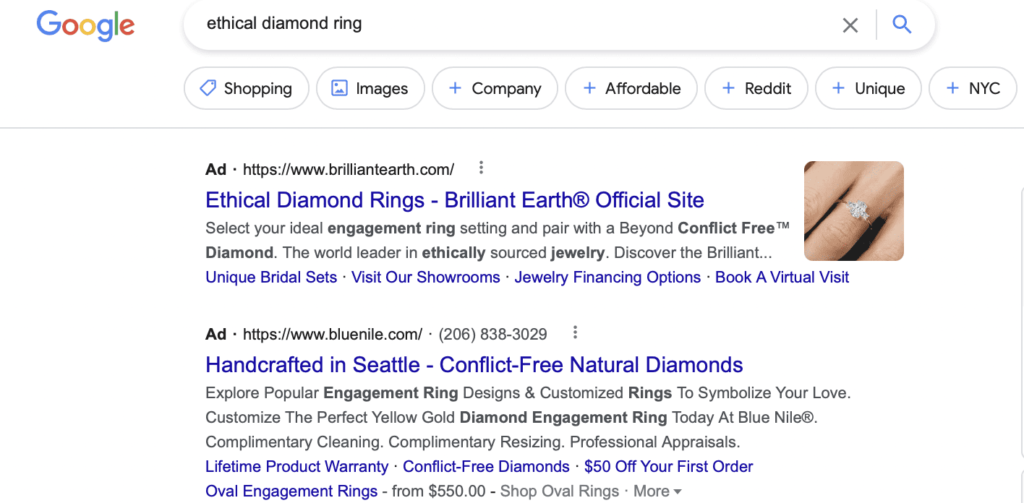
Google Ads operates on an auction-based system where advertisers bid on keywords aligned with user searches. Ad placement depends on bid value, relevance, expected click-through rate, and landing page experience, not just budget size.
The platform primarily follows a pay-per-click model, ensuring advertisers pay only when users take action. This performance-centric structure makes Google Ads a preferred channel for lead generation, sales acceleration, and ROI-focused acquisition strategies.
Google Ads supports multiple ad formats across Google’s ecosystem:
- Search Ads
- Display Ads
- YouTube Video Ads
- Shopping Ads
- Performance Max Campaigns
Google Ads also benefits from its unmatched search dominance, giving advertisers access to continuous, high-intent demand across nearly every industry.
Advantages of Google Ads
The following advantages highlight why Google Ads is often preferred by businesses seeking predictable, intent-led conversions and faster revenue impact. These strengths are most relevant when ROI and lead quality are primary performance indicators.
- High-Intent Traffic: Reaches users actively searching for solutions, resulting in stronger conversion probability and higher lead quality.
- Massive Search Reach: Access to Google’s daily searches, generating over 16.4 billion searches, allowing brands to scale acquisition without relying on audience discovery.
- Keyword-Level Control: Enables precise targeting based on commercial intent, reducing wasted spend on irrelevant audiences.
- Faster Time to Results: Drives immediate traffic and conversions, unlike organic channels that require long-term investment.
- Strong ROI for Certain Verticals: Performs exceptionally well for service-based, B2B, local, and high-ticket industries.
Disadvantages of Google Ads
Despite its performance strengths, the following limitations can impact efficiency and scalability, particularly in competitive markets or low-margin business models. These factors must be evaluated before committing significant budget.
- Rising Cost per Click: Competitive industries often face inflated CPCs, increasing acquisition costs over time.
- Limited Demand Creation: Captures existing demand but offers minimal impact at early awareness stages.
- Continuous Optimization Dependency: Requires active keyword management, bid adjustments, and quality score improvements.
- Landing Page Sensitivity: Poor landing page experience can significantly reduce performance and ROI.
- Saturation Risk: Over-reliance on search demand can limit scalability once keyword markets mature.
What is Facebook Ads?
Facebook Ads is a paid social advertising platform that allows businesses to promote products and services across Facebook, Instagram, Messenger, and Meta’s Audience Network.

Unlike search-based advertising, Facebook Ads reach users while they browse social feeds. Ads are delivered based on user demographics, interests, behaviors, and past interactions, making the platform effective for demand generation and mid-funnel nurturing.
Facebook Ads also operates on an auction system, primarily optimized for impressions, engagement, and conversions. Advertisers can rapidly scale reach, test multiple creative formats (e.g., Image Ads, video ads), and retarget users throughout the customer journey using Meta’s tracking and audience tools.
Advantages of Facebook Ads
The following advantages explain why Facebook Ads is widely used for building demand, scaling visibility, and nurturing audiences before they actively search for solutions.
- Advanced Audience Targeting: Facebook Ads can target users based on interests, behaviors, demographics, and lookalike audiences across the Meta ecosystem.
- Lower Cost Efficiency at Scale: Typically offers lower CPMs (than search paid), enabling brands to reach large audiences without high upfront spend.
- Creative-Led Engagement: Visual-first formats support storytelling, helping brands influence consideration and recall.
- Strong Retargeting Capabilities: Re-engages users through pixel-based tracking and engagement-based audience pools.
- Effective for Demand Creation: Enabling brands to create demand for new products, services, and categories without existing search demand.
Disadvantages of Facebook Ads
While powerful for awareness and engagement, Facebook Ads presents specific challenges that can impact direct-response performance and measurement accuracy.
- Lower Immediate Purchase Intent: Users are not actively searching, resulting in longer conversion cycles.
- Tracking and Attribution Limitations: Privacy updates and data restrictions reduce conversion visibility.
- Creative Fatigue Risk: Frequent exposure can reduce engagement, requiring continuous creative refresh.
- Heavy Dependence on Creative Quality: Performance is closely tied to visual assets and messaging effectiveness.
- Platform Dependency: Ad delivery is limited to Meta-owned properties, reducing cross-platform exposure.
5 Key Differences Between Google Ads vs Facebook Ads
Google Ads and Facebook Ads serve different business needs. To understand which delivers better ROI, let’s explore the key differences that separate both advertising platforms.
1. Audience Intent
Audience intent is the most critical difference between Google Ads and Facebook Ads. While both platforms offer massive reach, they influence users at very different stages of the buying journey.
Google Ads primarily captures active intent. Users search because they already recognize a problem or need and are actively evaluating solutions. This makes search traffic inherently conversion-oriented.
Facebook Ads, in contrast, work on passive intent. Users are not searching to buy. They are scrolling, discovering, and engaging with content, which makes Facebook a demand-creation channel rather than a demand-capture platform.
To understand the scale of intent difference, consider platform behavior:
| Platform | Core User Behavior | Intent Type |
| Google Ads | Actively searching for a solution/services | High Level |
| Facebook Ads | Browsing, engaging, and interest-based | Low/Mid Level |
Google processes over 16.4 billion searches per day, making it a dominant channel for users with immediate commercial intent. If users are not searching, however, Google Ads cannot generate demand.
Facebook, on the other hand, has 3.07 billion monthly active users, making it ideal for introducing products, shaping awareness, and influencing consideration before search demand even exists.
This distinction matters because ROI depends less on platform size and more on user mindset. If people are already searching, Google Ads wins. If they are not yet aware or motivated, Facebook Ads perform better.
The real question businesses must answer is not where audiences exist, but how they behave when encountering your offer.
2. Audience Targeting
Audience targeting defines how precisely an advertising platform can place your message in front of the right users. Google Ads and Facebook Ads approach targeting from fundamentally different data and intent models.
Talking of Google Ads, it relies primarily on keyword-driven targeting, where advertisers reach users based on what they actively search, the pages they visit, or the content they consume across Google’s ecosystem.
Its targeting becomes highly effective when businesses know exactly what users search for. Keywords act as direct intent signals, making targeting precise but limited to existing demand.
Along with it, Google Ads also offers remarketing and in-market audiences, but its targeting flexibility is narrower.
On the other hand, Facebook Ads uses people-based targeting. Ads are delivered based on who users are, how they behave, and what they engage with inside Meta’s ecosystem, even when they are not searching.
Facebook Ads excels at granular audience segmentation, in which advertisers can layer interests, behaviors, life events, and demographics to reach highly specific user groups before intent is formed.
Facebook’s strength becomes clearer with audience depth:
- Interest-based targeting across thousands of categories
- Behavioral signals like purchase activity and device usage
- Life-stage indicators such as parents, graduates, or movers
Another major advantage of Facebook Ads is lookalike audiences. These audiences allow businesses to scale by targeting users statistically similar to existing customers, improving efficiency without relying on search volume.
In practice, Google Ads works best when demand is defined. Facebook Ads perform better when audiences are niche, emerging, or require education before conversion.
3. Cost Comparison
Cost is often the first metric businesses compare, but it is also the most misleading when viewed in isolation.
From a cost perspective, Google Ads is largely intent-priced. Most advertisers pay on a cost-per-click model, especially for Search campaigns, where pricing is influenced by keyword competition, commercial intent, and Quality Score. Google also supports CPM-based buying across Display and YouTube, along with conversion-optimized bidding where the system prioritizes users most likely to take action rather than just click.
While Facebook Ads is primarily impression-priced. Advertisers usually pay on a CPM basis, effectively buying attention and reach. Cost efficiency improves through higher engagement, stronger creatives, and precise audience selection. While Facebook allows optimization for leads or purchases, pricing is still heavily influenced by creative performance and audience saturation rather than search demand.
| Platform | Avg CPC (USD) | Avg CPM (USD) | Avg Cost per Lead/Action (USD) |
| Google Ads | 5.26 | 78.64 | 70.11 |
| Facebook Ads (Meta) | 1.92 | 19.81 | 27.66 |
These benchmarks clarify why cost discussions often lack context. Google Ads generally carries a higher CPC and CPL because it captures users with immediate buying intent. Facebook Ads delivers lower CPMs and CPLs because it influences users earlier, relying on volume, repetition, and retargeting to drive conversions over time.
While costing is just one factor, there are several platform-specific factors that significantly influence how much you actually pay and how efficiently budgets convert into revenue.
Google Ads cost influencers:
- Keyword competition and intent strength, where high-commercial queries demand higher bids.
- Quality Score, driven by ad relevance, expected CTR, and landing page experience.
- Landing page conversion rate, which directly impacts effective CPL.
- Bid strategy selection, especially conversion-focused smart bidding.
- Geographic and device-level competition differences.
Facebook Ads cost influencers:
- Creative quality and engagement rate, which directly affect auction efficiency.
- Audience size and fatigue, particularly in narrow or heavily retargeted segments.
- Optimization event choice, such as clicks versus leads or purchases.
- Funnel strength, including offer clarity and the post-click conversion process.
- Seasonal competition spikes, especially during high-ad-spend periods.
Ultimately, Google Ads tends to penalize on weaker intent and landing pages, while Facebook Ads penalizes poor creatives and broad or fatigued audiences. Cost efficiency improves when campaigns align with how each platform prices attention and intent, not when platforms are compared on surface-level metrics alone.
4. ROI Comparison
ROI is the metric that ultimately decides whether paid advertising is profitable or simply expensive. While clicks and impressions show activity, ROI reflects how effectively ad spend converts into measurable business outcomes.
Businesses often misjudge ROI by focusing on surface metrics like CPC or CPM. In reality, ROI is shaped by conversion rates, cost per acquisition, and how closely the platform aligns with buyer intent.
Google Ads and Facebook Ads deliver ROI in different ways. One captures existing demand with high intent, while the other builds and nurtures demand over time through repeated exposure and engagement.
Below is a comparison of average conversion rates across industries, highlighting how ROI potential differs between both platforms.
| Industry | Google Ads Avg CVR (%) | Facebook Ads Avg CVR (%) |
| Arts & Entertainment | 4.84 | 9.34 |
| Attorneys & Legal Services | 5.09 | 10.53 |
| Beauty & Personal Care | 7.82 | 5.29 |
| Career & Employment | 4.33 | 5.77 |
| Dentists & Dental Services | 9.08 | 6.38 |
| Education & Instruction | 11.38 | 10.08 |
| Health & Fitness | 6.8 | 5.63 |
| Home & Home Improvement | 7.33 | 5.22 |
| Industrial & Commercial | 7.17 | 9.34 |
| Real Estate | 3.28 | 9.53 |
| Restaurants & Food | 7.09 | 18.25 |
| Sports & Recreation | 7.62 | 5.48 |
Conversion rates alone do not tell the full ROI breakdown. Cost per lead or action provides deeper insight into how efficiently each platform converts spend into outcomes. So, here are average benchmarks:
| Industry | Google Ads Avg CPL (USD) | Facebook Ads Avg CPL (USD) |
| Arts & Entertainment | 30.27 | 18.17 |
| Attorneys & Legal Services | 131.63 | 18.17 |
| Beauty & Personal Care | 60.34 | 51.42 |
| Career & Employment | 62.8 | 17.64 |
| Dentists & Dental Services | 83.93 | 76.71 |
| Education & Instruction | 90.02 | 28.22 |
| Health & Fitness | 62.8 | 52.98 |
| Home & Home Improvement | 90.92 | 41.26 |
| Industrial & Commercial | 85.63 | 37.34 |
| Real Estate | 100.48 | 16.61 |
| Restaurants & Food | 30.27 | 3.16 |
| Sports & Recreation | 47.47 | 19.3 |
When ROI is measured correctly, Google Ads typically delivers higher-intent leads at a higher acquisition cost, while Facebook Ads generates larger lead volumes at lower costs by influencing users earlier in the funnel.
Beyond platform mechanics, ROI improves when businesses actively optimize campaign variables that directly impact conversion efficiency and revenue contribution. Here are some factors to improve your ROI:
Google Ads ROI improvement factors:
- Prioritizing keywords with strong commercial and transactional intent
- Improving Quality Score through tighter ad relevance and landing page experience
- Using conversion-focused smart bidding strategies
- Optimizing landing pages to reduce friction after the click
- Applying advanced attribution models to assess revenue impact accurately
Facebook Ads ROI improvement factors:
- Strengthening creatives to increase engagement and auction efficiency
- Refining audience segmentation and exclusions to limit wasted reach
- Optimizing for high-value conversion events rather than clicks
- Building layered retargeting sequences across funnel stages
- Refreshing creatives frequently to control performance decay
Ultimately, ROI is driven by strategic alignment rather than platform selection. Google Ads rewards intent alignment and readiness to convert, while Facebook Ads rewards audience insight, creative strength, and structured funnel execution.
5. Ad Formats
Ad formats define how advertising messages are presented to users across platforms. Google Ads and Facebook Ads offer different format options because they operate in different environments and user contexts.
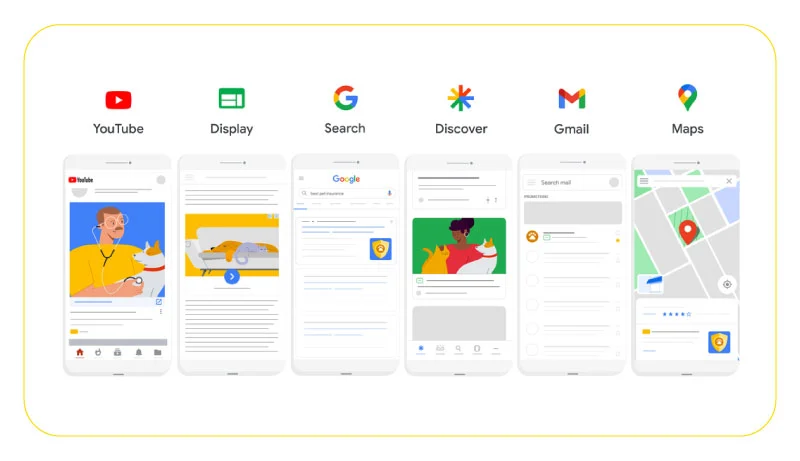
Google Ads primarily uses text-based and intent-aligned formats. Search ads appear on search results pages and rely on headlines, descriptions, and extensions to match user queries. Display and YouTube formats extend visibility across Google’s network.
Facebook Ads focuses on visual and interactive formats. Ads appear within feeds, stories, and short-form video placements, integrating with how users consume social content during browsing sessions.
Here are the supported ad formats for each ad platform.
Google Ads formats:
- Search ads
- Display ads
- YouTube video ads
- Shopping ads
Facebook Ads formats:
- Image ads
- Video ads
- Carousel ads
- Stories and Reels ads
- Collection ads
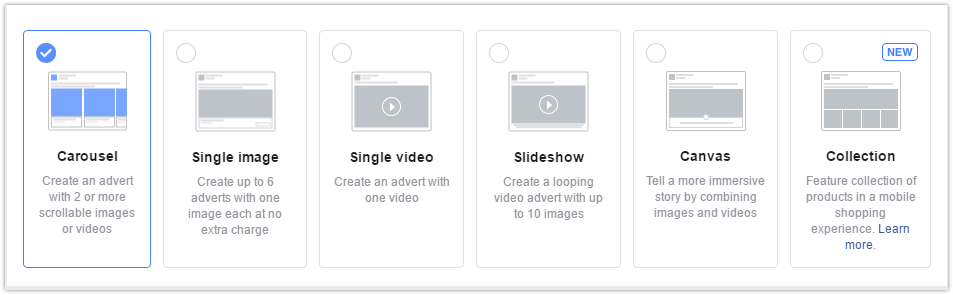
These format differences reflect how each platform delivers information. Google Ads emphasizes structured responses to searches, while Facebook Ads uses visual presentation within content feeds, allowing advertisers to adapt messaging based on placement and format.
Best Use Cases of Google Ads
Google Ads is most effective when users actively search for solutions, products, or services. Its strength lies in capturing existing demand where intent is explicit and conversion readiness is high.
For example, a law firm bidding on “personal injury lawyer near me” benefits because the user is already facing a legal issue and is actively seeking representation.
Similarly, B2B companies rely on Google Ads for searches like “CRM software for startups” or “HR payroll tools,” where buyers are comparing vendors and moving toward a purchase decision.
Here are some significant use cases demonstrating the implications of Google Ads:
- Service businesses targeting urgent, problem-based searches such as “emergency plumber near me,” “divorce lawyer consultation,” or “24/7 dental clinic.”
- B2B companies capturing solution-aware buyers searching for specific tools, platforms, or software categories.
- Local businesses competing for location-based intent like “best car repair shop in Bangalore” or “home renovation services nearby.”
- E-commerce brands promoting products with consistent, high-intent search demand, such as “buy wireless earbuds” or “gaming laptop under budget.”
- Brands intercepting evaluation-stage users through competitor or alternative queries like “HubSpot vs Salesforce” or “Shopify alternatives.”
Google Ads fits scenarios where intent is explicit, decision timelines are short, and conversions must be directly attributable to search behavior rather than long-term audience nurturing.
Best Use Cases of Facebook Ads
Facebook Ads are most effective when businesses need to introduce, shape, or expand demand rather than capture it immediately. It performs well when buying intent develops through repeated exposure and engagement.
For example, a DTC skincare brand promoting a new product benefits from Facebook Ads because users are not actively searching but can be influenced through visuals, education, and social proof.
Here’s how you can leverage Facebook Ads in scenarios such as:
- Brands launching new products or categories where search demand does not yet exist, such as new fitness programs or lifestyle apps.
- E-commerce businesses promoting visually driven products like fashion, beauty, home decor, or consumer gadgets.
- Businesses building demand through storytelling, offers, or education before users actively search.
- Brands nurturing longer sales cycles using retargeting across multiple touchpoints and sessions.
- Companies scaling reach through interest-based and lookalike audiences when search volume is limited.
Facebook Ads fits scenarios where awareness, consideration, and repeated engagement play a larger role in conversions than immediate intent-driven actions.
Facebook Ads vs Google Ads: Which Is Better for Your Business?
So, we did a detailed comparison between Google Ads and Facebook Ads, but one important question still remains: “Which one is better for my business?”
The answer depends less on the platform and more on how your business generates demand, converts users, and measures success. There is no universally better channel, only better alignment.
If your customers actively search for solutions, Google Ads often fits naturally. Search-driven intent shortens decision cycles and supports faster conversions tied directly to specific queries.
If your customers do not search immediately, Facebook Ads becomes relevant. It introduces products, shapes interest, and builds familiarity before purchase intent exists.
Decision-making becomes easier when viewed through business context rather than platform features.
Choose Google Ads when:
- Customer behavior is search-led, problem-aware, and action-oriented.
- Industries rely on urgent or solution-based demand such as legal, healthcare, home services, or B2B SaaS.
- Budgets are optimized for higher CPCs in exchange for stronger intent and lead quality.
- Sales journeys are short with fewer touchpoints between click and conversion.
- Business models depend on capturing existing demand within competitive markets.
Choose Facebook Ads when:
- Customer behavior is discovery-led, interest-driven, and influenced by visuals or messaging.
- Industries perform better with awareness and consideration, such as ecommerce, DTC, education, and lifestyle brands.
- Budgets need to scale reach efficiently through lower CPMs and controlled testing.
- Sales journeys involve multiple touchpoints, nurturing, and retargeting before conversion.
- Business growth depends on building demand rather than relying on existing search volume.
In many cases, businesses do not need to choose one platform exclusively.
The strongest results come from aligning platforms with customer behavior, sales timelines, and industry dynamics. When strategy leads platform selection, paid advertising becomes more predictable, scalable, and outcome-driven.
Add Comment