

Performance Marketing vs Content Marketing: Where You Should Bet in 2026?
The marketing landscape in 2026 is more competitive than ever.
Businesses are constantly choosing between immediate results and sustainable growth strategies, where some brands prioritize faster lead generation through paid campaigns, and others invest in content to build authority, trust, and long-term visibility.
This creates a critical decision point: “should you rely on performance marketing for rapid ROI or content marketing for consistent growth?”
The challenge is that both strategies solve different business problems. Choosing the wrong approach often leads to inefficient spending and slower growth momentum.
Here’s what recent data highlights (by ForbesAdvisor):
- Content marketing generates 3X more leads while costing 62% less than traditional outbound methods.
- On average, content marketing delivers $2.77 return for every $1 spent, making it a strong long-term investment.
At the same time, performance marketing continues to dominate when businesses need immediate traffic, measurable conversions, and faster scaling.
So the real question isn’t simply performance marketing vs content marketing.
It’s understanding how each strategy fits your growth stage, budget, and acquisition goals in today’s competitive market.
In this blog, we’ll break down performance marketing vs content marketing in a way that helps you confidently decide where to invest in 2026.
What is Performance Marketing?
Performance marketing is a digital marketing approach where advertisers pay only when a defined action happens, such as a click, lead, or sale.
Instead of spending on impressions alone, brands invest in measurable outcomes like clicks, leads, app installs, or completed purchases. This makes it one of the most accountable marketing approaches, where every rupee spent is directly tied to performance and ROI.
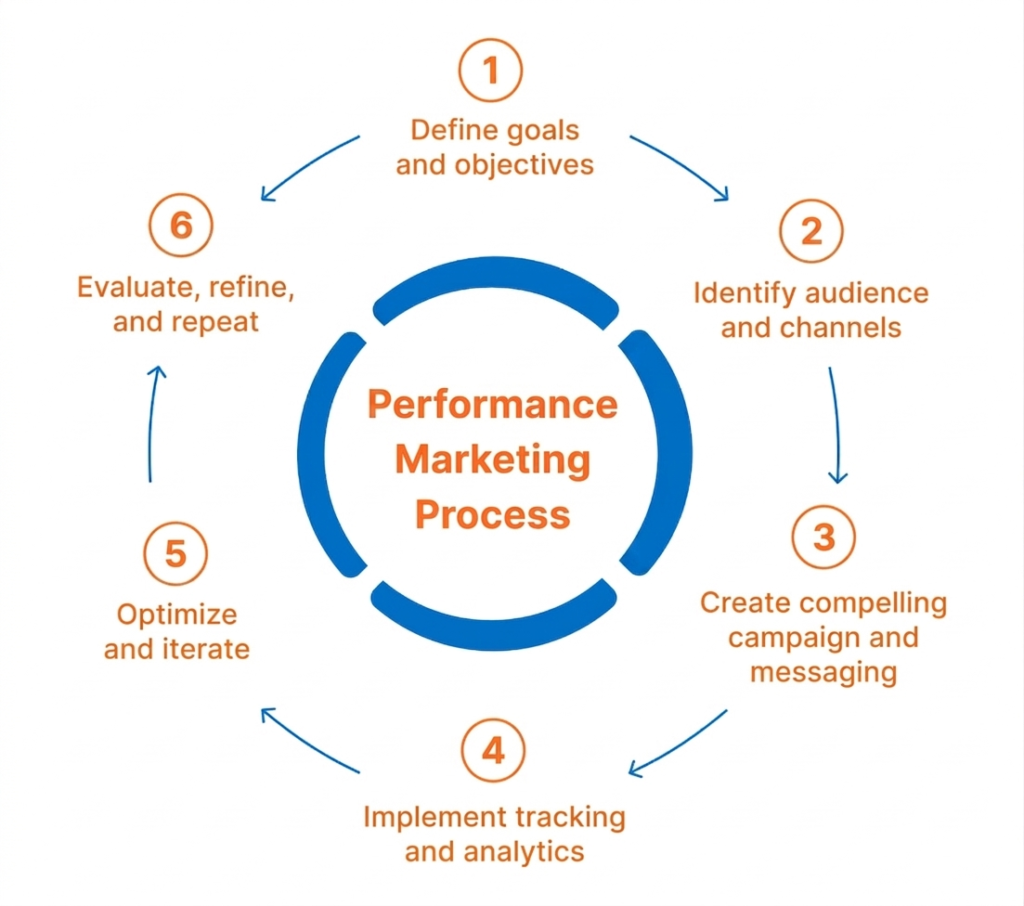
Here’s what defines performance marketing in practical terms:
- Pay-for-results model (CPC, CPA, CPL, ROAS).
- Real-time tracking of campaigns and user behavior.
- Continuous optimization based on performance data.
- Clear visibility into what’s driving conversions
Common channels used in performance marketing:
- Google Ads (search and display campaigns)
- Meta Ads (Facebook and Instagram advertising)
- YouTube and video advertising platforms
- Affiliate and partner-based marketing networks
What makes performance marketing powerful is its ability to generate immediate actions without waiting months for results to build. For example, pay-per-click advertising delivers an average ROI of around 200%, which means that every business earns roughly $2 for every $1 spent.
But across industries, performance marketing campaigns often see ROI ranges between 200% to 400% when optimized effectively.
However, performance marketing is not just about running ads. It’s a system that’s built on targeting, creatives, landing pages, and constant optimizations.
Also Check: Facebook Ads vs Google Ads: Which Is Better for Business ROI?
What is Content Marketing?
Content marketing is a long-term marketing strategy focused on creating and distributing valuable, relevant content to attract and retain a defined audience.
Instead of pushing direct promotions, it builds demand by educating users, solving problems, and positioning your brand as a trusted authority.
This approach focuses on earning attention organically rather than buying it, making it a core driver of sustainable traffic and inbound leads.
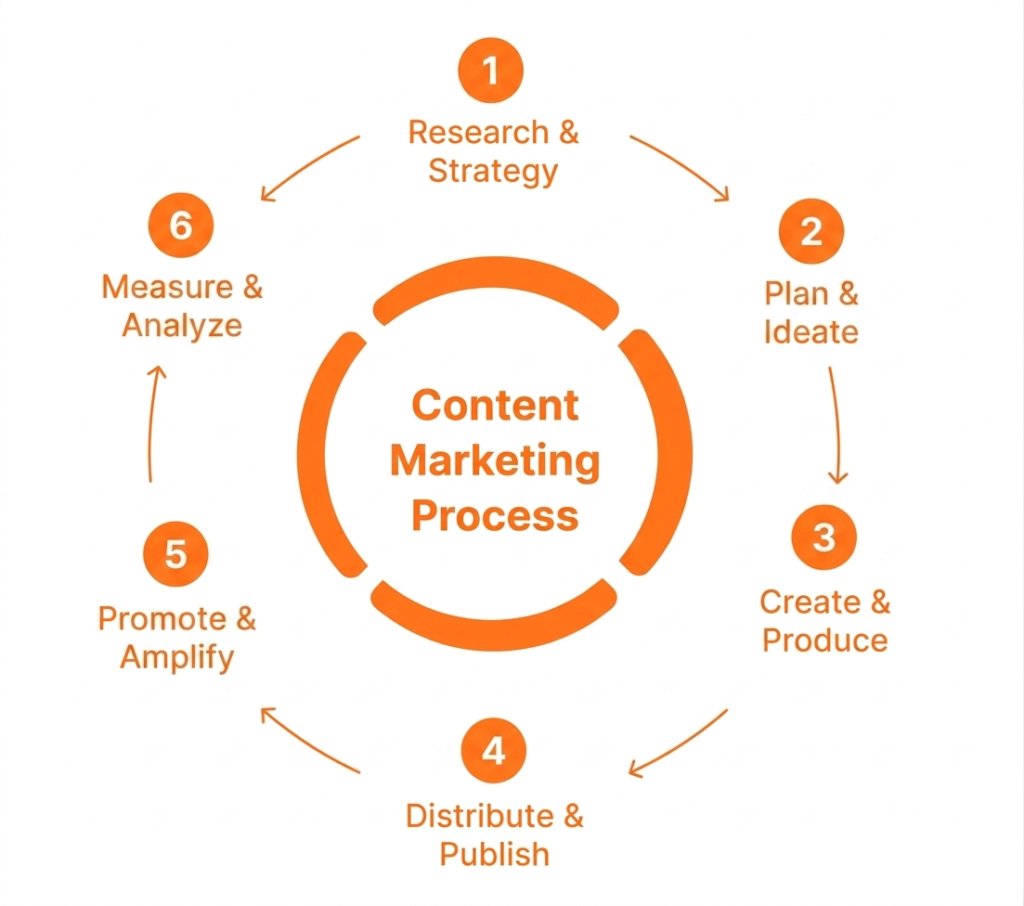
Here’s what content marketing typically includes:
- Blog articles and SEO-focused landing pages.
- Educational videos, guides, and tutorials.
- Social media content and short-form videos.
- Email newsletters and lead nurturing sequences.
What makes content marketing powerful is its compounding nature. Unlike paid campaigns, content keeps working even when you stop spending, making it one of the most cost-efficient growth strategies over time.
Here’s what the data shows:
- Content marketing generates over 3X more leads compared to outbound marketing while costing 62% less per lead.
- On average, businesses see around $2.77 return for every $1 invested in content marketing, proving its long-term ROI potential.
Another key advantage is buyer behavior. Most users consume multiple pieces of content before making any purchase decision.
In fact, B2B buyers typically go through 11+ content touchpoints before engaging with a sales team.
This makes content marketing essential not just for traffic, but for influencing decisions and building high-intent pipelines.
Also Read: Top 7 Content Marketing Strategies for B2B Growth in 2026
Performance Marketing vs Content Marketing: Key Differences
Performance marketing and content marketing are often compared, but they operate on completely different fundamentals, timelines, and growth mechanisms.
To make the right decision, you need to understand how they differ in execution, investment, and impact on your overall marketing strategy.
1. Timeframe of Results
The biggest difference between performance marketing and content marketing is how quickly results appear and how long they sustain.
Performance marketing is designed for speed. Campaigns can start generating clicks, leads, and sales within hours or days after launch. This makes it highly effective for product launches, limited-time offers, and aggressive acquisition goals where timing matters most.
Content marketing works on a slower cycle. It takes time for content to index, rank, and build authority across search engines. However, once it gains traction, it continues delivering traffic and leads consistently without ongoing ad spend.
| Factor | Performance Marketing | Content Marketing |
| Strategy Execution | 1–3 days setup speed | 15–60 days buildup |
| Research Depth | 3–5 data inputs used | 10–20 SEO inputs used |
| First Results | 24–72 hours | 30–120 days |
| Scaling Speed | Instant budget scaling | Gradual organic scaling |
| Sustainability | Stops when spending stops | 6–24 months compounding |
Performance marketing wins in urgency, while content marketing wins in durability and long-term growth momentum.
2. Cost Structure
Performance marketing costs you every single day. The moment your budget stops, your results stop too. That is not an asset. That is a running expense.
Content marketing demands upfront investment but builds something that keeps working long after you stop spending.
Here is what the numbers actually say:
- Average Google Ads CPL stands at $70.11 across industries.
- Meta Ads average CPL hit $41.60, up 21% year-over-year.
- Content marketing CPL dropped 19% year-over-year.
| Cost Factor | Performance Marketing | Content Marketing |
| Setup Cost | Low | High upfront |
| Ongoing Cost | Continuous | Minimal after publishing |
| Avg. CPL | $41 to $70 | $1 to $5 long term |
| Long-Term Efficiency | Declines without spend | Compounds over time |
Performance marketing CPLs are climbing. Content marketing CPLs are falling. The direction alone tells you where efficiency is heading in 2026.
3. ROI Nature
Fast ROI sounds impressive until it disappears the moment you pause your campaigns.
Performance marketing delivers measurable returns quickly. But those returns are entirely spend-dependent. No budget means no results. It is that direct.
Content marketing builds ROI you do not have to keep repurchasing.
- Google Ads delivers an average $2 return per $1 spent.
- Content marketing returns $7.65 per $1 spent on average.
- High-performing content strategies reach 844% ROI over three years.
| ROI Factor | Performance Marketing | Content Marketing |
| Short-Term ROI | High and immediate | Low initially |
| Long-Term ROI | Flat without spend | Compounds significantly |
| ROI After Pausing | Drops to zero | Continues generating |
| 3-Year ROI Potential | Budget-dependent | Up to 844% |
Performance marketing ROI is more like rented, whereas content marketing ROI is owned. Both matter, but only one builds an asset you keep forever.
4. Marketing Focus
Performance marketing and content marketing do not compete for the same job. Brands that treat them as direct substitutes consistently underperform brands that understand the difference.
Performance marketing targets buyers who are ready to act. Every element is engineered around one outcome, which is conversion.
Content marketing earns attention before buyers are ready. It builds the trust that makes every future campaign more effective.
- 87% of B2B marketers confirmed that content marketing created brand awareness in the last 12 months.
- 58% of consumers trust brands more when content is educational rather than promotional.
| Focus Area | Performance Marketing | Content Marketing |
| Primary Goal | Conversions and sales | Awareness and trust |
| Funnel Stage | Bottom | Top and middle |
| Brand Building | Minimal | Core to strategy |
| Relationship Depth | Transactional | Long-term |
Performance ads convert faster when buyers already trust you. While the content builds that trust before your ad ever appears.
5. Metrics and KPIs
Most brands measure content marketing on performance marketing timelines. That single mistake makes content look like it is failing when it is actually compounding.
Both strategies track entirely different signals, and comparing them on the same scorecard is where reporting goes wrong.
Performance Marketing KPIs: CPA, ROAS, CTR, CPL, Conversion Rate, etc.
Content Marketing KPIs: Organic traffic, keyword rankings, engagement rate, inbound leads, domain authority, etc.
| Metric Area | Performance Marketing | Content Marketing |
| Measurement Speed | Real time | Weeks to months |
| Attribution | Direct and trackable | Multi-touch and complex |
| Optimization Cycle | Daily to weekly | Monthly to quarterly |
| Success Signal | Conversions and revenue | Authority and pipeline growth |
Despite 83% of leaders prioritizing ROI demonstration, only 36% can accurately measure content marketing ROI, not because content does not work, but because multi-touch attribution is harder to isolate than last-click data.
Therefore, performance marketing metrics tell you what happened today. Whereas, content marketing metrics tell you what is being built for tomorrow.
Benefits of Performance Marketing
Speed is not a luxury in business. Sometimes it is the only thing that keeps you alive.
Performance marketing gives you exactly that. You launch a campaign, set your budget, and results start flowing within hours. No waiting, no guessing.
Here is what makes it non-negotiable for growth-focused brands:
- Instant traffic from day one without building anything organically.
- Full budget control with daily spend caps and real-time adjustments.
- Precise targeting based on audience behavior, intent, and demographics.
- Real-time data to optimize campaigns before money gets wasted.
- Scalability on demand — double your budget, scale your results.
Organizations that actively track and analyze their campaign performance metrics are 2.3x more likely to exceed their revenue goals.
Performance marketing does not reward patience. It rewards precision. Every rupee is tracked, every decision is data-backed, and every campaign is built to deliver measurable outcomes from the start.
Benefits of Content Marketing
Paid campaigns stop working the moment you stop paying. Content never does.
That is the single most underestimated advantage of content marketing and the reason brands with long-term thinking continue doubling down on it every year.
Here is what consistent content investment actually builds:
- Organic traffic that compounds without ongoing ad spend.
- Brand authority that makes buyers trust you before they even reach your sales team.
- Inbound leads from high-intent users actively searching for your solution.
- Lower CPL over time as content assets keep performing for months and years.
- SEO presence that competitors cannot simply outspend overnight.
Companies using blogs generate 55% more website traffic and 67% more leads compared to non-blogging peers.
Content marketing does not generate overnight wins. It builds something more valuable that keeps filling even when your team is not actively working on it.
When Should You Choose Performance Marketing?
Not every business problem needs a slow-burn solution. Some situations demand immediate results, and waiting for organic growth is simply not an option.
Performance marketing is the right call when:
- You need leads or sales right now: A new product launch, a limited-time offer, or a revenue gap that cannot wait three months for SEO to compound.
- You are entering a new market: Paid campaigns let you test audience segments, messaging, and offers quickly before committing to long-term content investment.
- You have a budget but no organic presence: Performance marketing bridges the gap while your content strategy builds traction in the background.
- You want to test before you scale: Performance marketing allows real-time tracking of campaign performance with data-driven insights that inform future strategies.
If your timeline is short and your goals are conversion-driven, performance marketing is where your budget belongs first.
When Should You Choose Content Marketing?
Some brands want traffic. The best brands want authority. Those are two very different goals, and only one of them compounds.
Content marketing is the right investment when:
- You are building for the long term: Brands that want consistent inbound leads, growing organic traffic, and a pipeline that does not depend on ad spend need content at the core.
- Your buyers research before they buy: 67% of B2B buyers consume at least five pieces of content before engaging with a sales rep, and if your content is not in that research journey, a competitor’s is.
- You operate in a longer sales cycle: B2B brands, service businesses, and high-consideration products need content to nurture buyers across multiple touchpoints before a decision is made.
- You want to reduce paid dependency over time: Every content asset you publish is a step toward lowering your CPL and reducing the budget required to sustain your pipeline.
Content marketing is not the fastest choice. It is the smarter one for brands building something that lasts.
Performance Marketing vs Content Marketing: Which is Better in 2026?
Neither. That is the honest answer most people will not give you.
The real question was never which strategy is better. It was always about which strategy fits your current stage, budget, and growth goal.
Performance marketing wins when you need results now. Content marketing wins when you are building something that lasts. Both serve different stages of the same buyer journey.
Here is what the data actually confirms:
- Companies that blend brand-building efforts with conversion tactics achieve 15 to 20% higher ROI compared to those focusing only on immediate sales.
- First-touch attribution shows content initiates 67% of B2B buyer journeys, making it the starting point of most purchase decisions.
- SEO leads have a 14.6% close rate, compared to just 1.7% for outbound leads, proving that organic trust converts far more efficiently.
Even user behavior has shifted permanently. Today, buyers research before they trust, and they trust before they buy. Performance marketing captures that final decision. Content marketing earns everything that comes before it.
The brands winning in 2026 are not choosing between the two. They use both with clear intention at every stage of the funnel.
When Should Brands Use Performance Marketing and Content Marketing Together?
The biggest growth mistake brands make is treating these two strategies as separate budgets with separate goals. They are not.
Here is how the most effective brands are combining them in 2026:
- Performance marketing brings the traffic, Content marketing earns the trust: Use paid campaigns to drive immediate reach, then let your content convert that audience over time through education and authority.
- Use paid campaigns to amplify your best content: Your highest-performing blog posts, guides, and videos deserve paid distribution. When brand and performance efforts are combined, ROI can increase by up to 90% because awareness makes conversion campaigns significantly more effective.
Build a full-funnel strategy that connects every stage:
| Funnel Stage | Strategy | Goal |
| Awareness (TOFU) | Content marketing and SEO | Attract and educate |
| Consideration (MOFU) | Retargeting and nurture content | Build trust and intent |
| Conversion (BOFU) | Performance ads and strong CTAs | Drive action and revenue |
- Use performance data to make smarter content decisions: Your paid campaigns reveal which audiences, messages, and offers convert best. Feed that data into your content strategy to build assets that attract the same high-intent buyers organically.
Adopting a full-funnel strategy that combines brand awareness with performance marketing can lift overall marketing ROI by 15 to 20%.
This is not a balanced approach for the sake of balance. It is the only strategy built to win at every stage of how modern buyers actually make decisions.
Conclusion
Choosing between performance marketing and content marketing is the wrong question entirely.
Performance marketing gives you speed and immediate ROI. Content marketing builds authority and a pipeline that compounds over time. The most successful brands in 2026 are using both with a clear strategy behind every decision.
The real question is where your business stands right now.
If you need leads fast, performance marketing gets you there. If you are building long-term organic growth, content marketing is your foundation. And if you want both, the answer is a balanced full-funnel strategy that connects every stage of your buyer journey.
Ready to build a marketing strategy that fits your growth goals? Let’s talk.
Add Comment